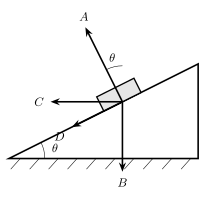
Q.Circular motion of a car on a banked road is shown in figure
You're viewing a preview — the full solution, concept, methods & PYQ mapping are locked.
Start your 14-day free trial to unlock the full solution →On a car turning on a banked road, the only real forces on the car are its weight (down), the normal reaction (perpendicular to the road surface) and friction (along the surface); their horizontal resultant supplies the centripetal force needed for the turn, while their vertical resultant balances the weight. Static friction never exceeds and adjusts itself, up to that limit, to whatever is needed to prevent sliding.
(a) Identifying the forces A, B, C, D
Only three forces genuinely act on the car: its weight, the normal reaction from the road, and friction. The figure additionally marks the net horizontal force the car needs for the turn, for reference. Reading the figure as described:
- A — drawn perpendicular to the banked surface, pointing up and outward — is the Normal reaction, , exerted by the road surface on the car.
- B — drawn straight down from the car — is the Weight of the car, , acting vertically downward due to gravity.
- C — drawn horizontally — represents the centripetal force required for the circular turn, : the net horizontal force that the combination of and must supply to keep the car moving on its circular path (it is not a separate applied force, but the required resultant, shown for reference).
- D — drawn along the inclined surface, in the down-slope direction — is the Force of friction, , acting along the road surface. It acts down the slope here because, at higher speeds, the car tends to slide up and outward on the bank, and friction opposes this tendency.
(b) Equations along the horizontal and vertical directions
Resolve (perpendicular to the surface) and (along the surface) into horizontal and vertical components, using the angle of banking :
- has components (vertical, upward) and (horizontal, towards the centre of the turn).
- , acting down the slope, has components (vertical, downward) and (horizontal, towards the centre of the turn).
The car has no vertical acceleration, so the vertical forces balance:
The car does have a horizontal (centripetal) acceleration , directed towards the centre of the circular path, so the net horizontal force equals :
…
Unlock everything free for 14 days
- Full step-by-step solutions
- Concept-first explanations
- Methods, shortcuts & mistakes
- PYQ mapping + timed mock tests
Full access for 14 days. No credit card required.