Q.Banking of roads helps to increase the limit of maximum safe speed of a vehicle at a curve.
You're viewing a preview — the full solution, concept, methods & PYQ mapping are locked.
Start your 14-day free trial to unlock the full solution →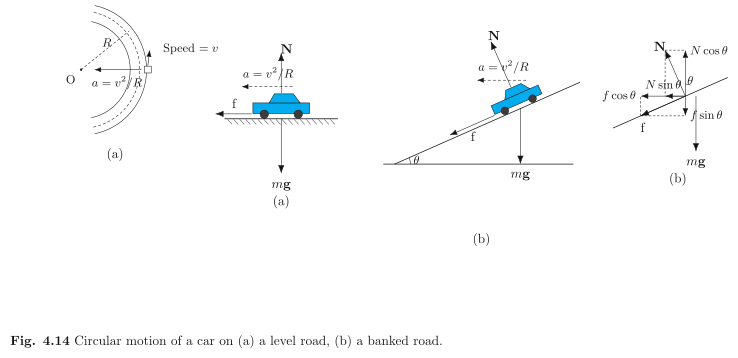
On a flat road, only friction between the tyres and the road can supply the centripetal force needed to turn, which caps the safe speed at v_max = √(μsgr). Banking the road tilts the normal force so that a component of it points toward the centre of the curve as well, supplying (or supplementing) the centripetal force — this is why banking raises the maximum safe speed.
Setup
Consider a car of mass m going round a curve of radius r on a road banked at angle θ to the horizontal. Two forces act on the car (ignoring friction first, to find the ideal banking speed): the weight mg (vertically down) and the normal reaction N (perpendicular to the road surface, so tilted at angle θ from the vertical).
Resolve N into vertical and horizontal components
-
Vertical: N cosθ, which must balance the weight (the car neither sinks into nor lifts off the road):
-
Horizontal: N sinθ, which points toward the centre of the circular path and must supply the required centripetal force mv²/r:
Divide (2) by (1)
This is the speed at which the car can round the banked curve with no reliance on friction at all.
Why banking increases the maximum safe speed
…
Unlock everything free for 14 days
- Full step-by-step solutions
- Concept-first explanations
- Methods, shortcuts & mistakes
- PYQ mapping + timed mock tests
Full access for 14 days. No credit card required.