Q.(a) Sketch the schematic diagram of a vehicle on a banked road and mark various forces acting on it.
You're viewing a preview — the full solution, concept, methods & PYQ mapping are locked.
Start your 14-day free trial to unlock the full solution →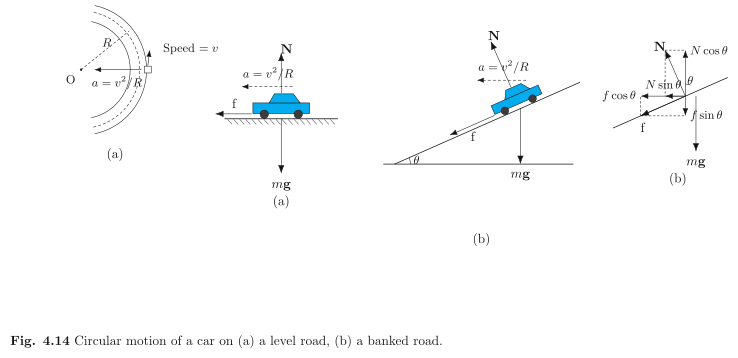
On a frictionless banked curve, only the normal reaction and weight act on the vehicle; resolving the normal reaction into horizontal and vertical components and requiring the horizontal component alone to supply the centripetal force gives the maximum safe speed v = √(rg tanθ).
(a) Schematic description: The road surface is banked (inclined) at an angle θ to the horizontal, and the vehicle moves along a circular path of radius r on this banked curve. Two forces act on the vehicle (friction being neglected):
- The weight, mg, acting vertically downward at the vehicle's centre of mass.
- The normal reaction, N, acting perpendicular to the (inclined) road surface, i.e., tilted at angle θ from the vertical.
(A simple sketch would show the vehicle on the inclined road surface, with mg drawn straight down, and N drawn perpendicular to the sloped surface, tilted toward the centre of the circular track.)
(b) Since the road is frictionless, the normal reaction N is the only force (besides gravity) available to provide the necessary centripetal force. Resolve N into two components:
- Vertical component: N cosθ, which balances the weight mg (since the vehicle does not accelerate vertically): N cosθ = mg ... (1) …
Unlock everything free for 14 days
- Full step-by-step solutions
- Concept-first explanations
- Methods, shortcuts & mistakes
- PYQ mapping + timed mock tests
Full access for 14 days. No credit card required.