Q.Which of the following cannot be prepared by Sandmeyer's reaction?
(Two or more options may be correct.)
🔒You're viewing a preview — the full solution, concept, methods & PYQ mapping are locked.
🔒 Start your 14-day free trial to unlock the full solution →Concept understanding — Electrophilic Aromatic Substitution
Electrophilic Aromatic Substitution – The First Meeting
Imagine you have a benzene ring — that perfect, flat hexagon of six carbons with alternating double bonds. It's stable, almost stubbornly so. You want to attach something new to it, say a bromine atom or a nitro group. But benzene doesn't react like an alkene. It doesn't just add across a double bond. Instead, it does something more elegant: it kicks out a hydrogen and keeps its aromatic ring intact.
That's the heart of Electrophilic Aromatic Substitution (EAS).
The Intuition: Why "Substitution" and Not "Addition"?
Benzene's stability comes from its delocalised π electrons — a cloud above and below the ring. This cloud is electron-rich, so it attracts electrophiles (electron-loving species). But if an electrophile simply added to a double bond, the ring would break its aromaticity, losing that huge stabilisation. That would be energetically costly.
So benzene does something smarter: it lets the electrophile attack, temporarily breaks aromaticity to form a high-energy intermediate (the arenium ion), and then loses a proton to restore the aromatic ring. The net result? A hydrogen is replaced by the electrophile. The ring is back to its stable, aromatic self.
The key trade-off: temporary loss of aromaticity is acceptable because the final product regains it. Addition reactions would permanently destroy aromaticity — benzene avoids that.
The Precise Statement
Electrophilic Aromatic Substitution is a reaction in which an electrophile (E+) replaces a hydrogen atom on an aromatic ring, proceeding through a sigma complex (arenium ion) intermediate, and restoring aromaticity after deprotonation.
The general equation:
Ar−H+EX+Ar−E+HX+
where Ar represents an aromatic ring.
The Mechanism in Three Steps
-
Generation of the electrophile – Many EAS reactions need a catalyst to create a strong enough E+. For example, bromination uses FeBrX3 to polarise BrX2 into BrX+.
-
Attack by the aromatic ring – The π electrons of benzene attack the electrophile, forming a sigma complex (also called the arenium ion or Wheland intermediate). This intermediate is non-aromatic — it has four π electrons delocalised over five carbons, and one sp3 carbon bearing the electrophile and a hydrogen.
Benzene+E+⟶Sigma complex (non-aromatic)
- Deprotonation – A base (often the counterion of the catalyst, like FeBrX4X−) removes the proton from the sp3 carbon. The pair of electrons from the C–H bond flows back into the ring, restoring the aromatic sextet.
Sigma complex+Base⟶Product+HX+
The sigma complex is not aromatic. It's a high-energy intermediate. Students often mistakenly think it's still aromatic — it isn't. That's why the step is fast and the complex is short-lived.
Why This Matters for Exams
EAS is the gateway to understanding how to put groups onto benzene rings. The rate-determining step is usually the formation of the sigma complex (step 2). The regiochemistry (where the electrophile goes) depends on whether the ring already has a substituent — that's the topic of activating/deactivating groups and ortho/para vs. meta directors.
But for now, remember this: …
Why this formula?
Electrophilic Aromatic Substitution: Why the Mechanism Holds
The Core Puzzle: Why Benzene Doesn't Just Add
Benzene (C6H6) has three double bonds — so why doesn't it undergo addition reactions like alkenes?
The answer lies in aromatic stabilisation: benzene's delocalised π-electron cloud (the "aromatic sextet") is about 150 kJ/mol more stable than a hypothetical cyclohexatriene with localised double bonds.
If benzene simply added an electrophile (like Br2), it would lose this stabilisation — a huge energy penalty.
So, nature chooses a different path: substitution instead of addition, preserving the aromatic ring.
The Key Formula: The Reaction Profile
The rate-determining step in electrophilic aromatic substitution (EAS) is the formation of the arenium ion (σ-complex):
Ar-H+E+slowAr-E+H(σ-complex)
Then, fast deprotonation restores aromaticity:
Ar-E+H+B−fastAr-E+BH
Why This Holds: The Energy Barrier Logic
-
First step (slow): The electrophile E+ attacks the electron-rich ring. The σ-complex is non-aromatic — it has only 4 π-electrons delocalised over 5 carbons (the sixth carbon is sp3 hybridised). This intermediate is higher in energy than the starting benzene.
-
Second step (fast): A base removes the proton, restoring the aromatic sextet. This step is strongly exothermic — the system regains ~150 kJ/mol of stabilisation.
The overall reaction is exothermic, but the activation energy is dominated by the destabilisation of the σ-complex.
The Rate Law: Why It's First Order in Both
From the mechanism:
Rate=k[Arene][E+]
Reasoning:
- The slow step involves one molecule of arene and one molecule of electrophile.
- No other species appear before the rate-determining step.
- Therefore, the rate law is bimolecular — first order in each reactant.
This is not derived from the overall stoichiometry — it comes directly from the molecularity of the slow step.
The Hammett Equation: Quantifying Substituent Effects
For substituted benzenes, the rate constant k relative to benzene (k0) follows:
logk0k=σρ
Why This Holds
- σ (sigma constant): Measures the electronic effect of a substituent (electron-donating or withdrawing) relative to hydrogen. It is derived from the ionisation constants of benzoic acids — a purely empirical scale.
- ρ (rho constant): Measures the sensitivity of the reaction to substituent effects. A positive ρ means the reaction is favoured by electron-withdrawing groups (rare in EAS); a negative ρ means electron-donating groups accelerate the reaction.
Why it works:
The σ-complex has a positive charge delocalised over the ring. Substituents that stabilise this positive charge (electron-donating groups like −OH, −NH2) lower the activation energy — hence σ is negative for such groups. Electron-withdrawing groups (−NO2, −CN) destabilise the σ-complex — σ is positive.
The linear free-energy relationship holds because the transition state resembles the σ-complex in charge distribution.
The Directing Effect: Why Ortho/Para vs Meta
The position of substitution is governed by the stability of the σ-complex for each possible attack site. …
The key idea is that Sandmeyer's reaction specifically uses a copper(I) halide (CuCl or CuBr) to replace an aryl diazonium group with Cl or Br -- it does not extend to iodine or fluorine.
Step 1: Sandmeyer's reaction is ArN2+CuXArX, where X = Cl or Br only.
Step 2: Iodobenzene is instead made by simply treating the diazonium salt with KI -- no copper catalyst is needed, so this is a different reaction, not Sandmeyer's. …
Sandmeyer’s reaction replaces a diazonium group with Cl, Br, or CN using Cu(I) salts — it does not work for fluorine or iodine directly. Fluorobenzene is made via the Balz–Schiemann reaction, and iodobenzene is made by simply treating the diazonium salt with KI (no copper needed). So the compound that cannot be prepared by Sandmeyer’s reaction is fluorobenzene; iodobenzene is prepared by a different (but related) method, so it too is not a Sandmeyer product. The correct options are (C) and (D).
The Concept: Electrophilic Aromatic Substitution vs. Diazonium Chemistry
Sandmeyer’s reaction is a classic method to introduce a halogen (or a cyano group) onto an aromatic ring. It starts with an aniline (primary aromatic amine), which is first converted to a diazonium salt using nitrous acid (NaNO₂ + HCl) at 0–5 °C. This diazonium salt is then treated with a copper(I) halide (CuCl, CuBr) to give the corresponding aryl halide.
The key insight: the reaction works because the Cu(I) salt helps transfer a halogen radical to the aryl radical formed after N₂ leaves. But this mechanism only works smoothly for chlorine and bromine. For fluorine, the CuF is too unstable and the reaction fails. For iodine, the diazonium salt is so reactive that simply adding KI (without any copper) gives iodobenzene — that’s a different reaction, not Sandmeyer’s.
A common mistake is to think Sandmeyer’s reaction gives all four halogens. In fact, it gives only Cl and Br (and CN). Iodobenzene is made by a separate iodination of the diazonium salt, and fluorobenzene by the Balz–Schiemann reaction (thermal decomposition of a diazonium tetrafluoroborate).
Step-by-Step Reasoning
- What is Sandmeyer’s reaction? The general reaction is:
ArN2+X−CuXArX+N2
where X = Cl, Br, or CN. The copper(I) halide acts as a catalyst/radical source.
- Check each option:
- (A) Chlorobenzene: Made by treating benzenediazonium chloride with CuCl. ✓ Works.
- (B) Bromobenzene: Made by treating benzenediazonium bromide with CuBr. ✓ Works. …
Concept: Sandmeyer Reaction
The Sandmeyer reaction is a method to replace a diazonium group (−N2+) with a halogen (Cl, Br, I) or a cyano group (−CN) using a copper(I) salt as a catalyst.
Key Fact to Remember
- Chlorobenzene, bromobenzene, and iodobenzene can be prepared via Sandmeyer reaction using CuCl, CuBr, and CuI/KI respectively.
- Fluorobenzene cannot be prepared by Sandmeyer reaction — it is prepared by the Balz–Schiemann reaction (diazonium tetrafluoroborate thermal decomposition).
Method: Fact-Recall with Elimination
Steps:
- Recall the general reaction
ArN2+X−CuXArX+N2
where X=Cl,Br,I (but not F).
- Check each option: …
Here is a breakdown of the common mistakes students make regarding Sandmeyer’s reaction and how to avoid them.
The Core Concept (The "Why")
Sandmeyer’s reaction is a method to replace the diazonium group (−N2+) with a halogen (Cl, Br, I) or a cyano group (−CN) using a cuprous halide (CuX) or cuprous cyanide (CuCN) as a catalyst.
- General Reaction: ArN2+X−CuXArX+N2 (where X = Cl, Br, I, CN)
- The Key Limitation: This reaction does not work for preparing fluorobenzene (C6H5F). Fluorine is introduced via a different method (the Balz-Schiemann reaction), which uses HBF4 (fluoroboric acid) and heat, not CuF.
Common Mistake #1: Assuming all halogens work the same way
The Mistake: Students think that because Sandmeyer’s reaction works for Cl, Br, and I, it must also work for F. They treat all halogens as interchangeable.
Why it’s wrong: The reaction mechanism relies on the cuprous halide (CuX) to transfer the halogen. Cuprous fluoride (CuF) is unstable and does not participate in the catalytic cycle effectively. The fluoride ion (F−) is also too small and highly solvated, making it a poor nucleophile in this context.
How to Avoid:
- Memorise the exception: Write down: “Sandmeyer = Cl, Br, I, CN. NOT F.”
- Link to the alternative: Whenever you see “fluorobenzene,” immediately think Balz-Schiemann reaction (diazonium salt + HBF4 → heat → ArF).
- Visual cue: Draw a table in your notes:
| Halogen | Sandmeyer? | Reagent Used |
|---|---|---|
| Cl | ✓ Yes | CuCl |
| Br | ✓ Yes | CuBr |
| I | ✓ Yes | CuI (or KI alone also works) |
| F | ✗ No | HBF4 (Balz-Schiemann) |
Common Mistake #2: Forgetting that Iodobenzene can be prepared
The Mistake: Students think that because iodine is large and less reactive, it cannot be introduced via Sandmeyer’s reaction. They incorrectly mark Iodobenzene as the answer.
Why it’s wrong: While it’s true that CuI is less common, the reaction works. In fact, iodobenzene is often prepared even more easily by simply treating the diazonium salt with potassium iodide (KI) without needing CuI (this is called the Gattermann reaction or direct iodination). But the standard Sandmeyer method (using CuI) is also valid.
How to Avoid:
- Remember the trend: The Sandmeyer reaction works for all three: Cl, Br, and I. The only exception is F.
- Practice the specific question: If the options are (A) Chlorobenzene, (B) Bromobenzene, (C) Iodobenzene, (D) Fluorobenzene — the only correct answer is (D).
- Don’t overthink reactivity: Just because iodine is less reactive in some contexts doesn’t mean it’s excluded here.
--- …
- KEAM 2026Set eng-2026-04174 marksMCQQ.p-Bromophenol is the major product formed when phenol is treated with (A) Bromine water (B) Br2 in acetic acid at 300K (C) Br2 in CCl4 at 300K (D) Br2 in CS2 at 273K (E) Br2 in acetone at 273K
›Reveal solutionSolution
Using Br2 in the non-polar solvent CS2 at low temperature (273 K) suppresses polybromination and gives p-bromophenol as the major monobrominated product.
Phenol is strongly activated, so bromine water (polar, ionising) gives 2,4,6-tribromophenol.
To stop at monobromination, a low-polarity solvent and low temperature are used, which lowers the electrophilicity/availability of Br+. …
- KEAM 2026Set eng-2026-04224 marksMCQQ.When phenol is treated with excess of bromine water, it gives (A) o-bromophenol (B) o- and p-bromophenol (C) 1,3,5-tribromophenol (D) 2,4-dibromophenol (E) 2,4,6-tribromophenol
›Reveal solutionSolution
Phenol with excess bromine water undergoes electrophilic substitution at the ortho and para positions, giving a white precipitate of 2,4,6-tribromophenol. …
- KEAM 2026Set pha-2026-0418F4 marksMCQQ.Aniline reacts with acetic anhydride in pyridine to give a product which reacts with Br2 in CH3COOH to get (A) o-bromoaniline (B) p-bromoaniline (C) p-bromoacetanilide (D) o-bromoacetanilide (E) m-bromoacetanilide
›Reveal solutionSolution
Aniline → acetanilide (acetic anhydride/pyridine) → bromination gives mainly p-bromoacetanilide.
Aniline is acetylated to acetanilide C6H5NHCOCH3. The acetamido group is an activating ortho/para director, but the bulky −NHCOCH3 hinders the ortho positions, so electrophilic bromination with Br2/CH3COOH occurs predominantly at the para po …
- KEAM 2026Set pha-2026-0420F4 marksMCQQ.Which of the following reaction yieldstarry oxidation products? (A) Sulphonation of aniline (B) Nitration of aniline (C) Firedel-Crafts alkylation aniline (D) Firedel-Crafts alkylation of aniline (E) Bromination of aniline
›Reveal solutionSolution
Aniline is readily oxidised; direct nitration with HNO3/H2SO4 oxidises it to dark tarry products, so the amino group is protected (acetylated) first.
Aniline is very easily oxidised because the ring is electron-rich. When it is subjected to direct nitration with the strongly oxidising nitrating mixture (HNO3/H2SO4), a large part of it is oxidised to dark, tarry products rather than cleanly nitrated. This is exactly why, in practice, aniline is first acetylated ( …
- KEAM 2025Set eng-2025-04264 marksMCQQ.Phenol is treated with Con.H2SO4 to gives a product 'X' which on treatment with Con.HNO3 gives compound 'Y'. The compounds 'X' and 'Y' are respectively (A) Phenol-2-sulphonic acid and 2-nitrophenol (B) Phenol-2-sulphonic acid and 4-nitrophenol (C) Phenol-2-sulphonic acid, mixture of 2-nitrophenol and 4-nitrophenol (D) Phenol-2,4-disulphonic acid, mixture of 2-nitrophenol and 4-nitrophenol (E) Phenol-2,4-disulphonic acid and picric acid
›Reveal solutionSolution
Sulphonation of phenol gives phenol-2,4-disulphonic acid; subsequent nitration replaces the –SO3H groups to yield picric acid (2,4,6-trinitrophenol).
Treating phenol with concentrated H2SO4 introduces sulphonic acid groups, giving phenol-2,4-disulphonic acid (X). On treatment with concentrated HNO3, the readily displaceable sulphonic groups are replaced by nitro groups and the ring is further nitrated, producing picric acid (2,4,6-trinitrophenol, Y). …
- KEAM 2025Set eng-2025-04284 marksMCQQ.In the following reaction, the final product B is C6H5NH2(CH3CO)2OPyridineABr2CH3COOHB (A) A benzene ring with NHCOCH3 at position 1, Br at position 2 (ortho), and CH3 at position 4 (para) (B) A benzene ring with NHCOCH3 at position 1, Br at position 2 (ortho), and CH2Br at position 4 (para) (C) A benzene ring with NHCOCH3 at position 1, Br at position 3 (meta), and CH3 at position 4 (D) A benzene ring with NHCOCH3 at position 1, COCH3 at position 2 (ortho), and CH3 at position 4 (para) (E) A benzene ring with NHCOCH3 at position 1 and Br at position 4 (para)
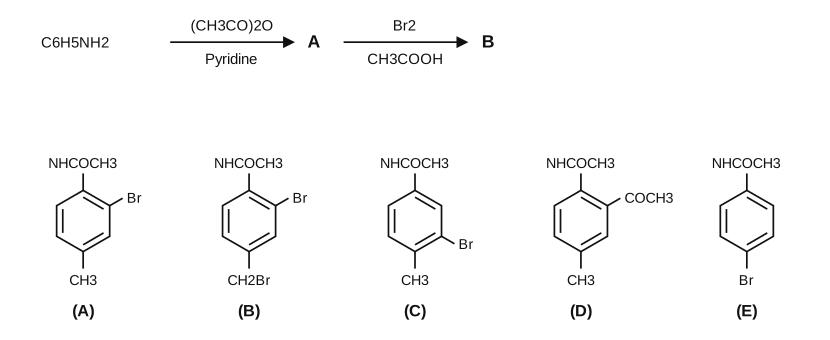
›Reveal solutionSolution
Acetylation moderates aniline; the acetamido group is an o/p-director and bromination gives mainly the para product.
C6H5NH2 + (CH3CO)2O/pyridine → acetanilide (A), C6H5NHCOCH3. The acetamido group is a strong ortho/para director; steric factors make the para product dominant. With Br2/CH3COOH the final product B is **p-bromoacetan …
- KEAM 2025Set eng-2025-04294 marksMCQQ.What is the major product of the following reaction? 4-methylphenol (p-cresol) +Br2FeBr3 ? (A) a benzene ring with an -OBr group (para) and a -CH2Br group (B) phenol with a Br substituent ortho to the -OH (2-bromophenol) (C) a phenol (-OH) with a Br ortho to the OH and a -CH3 group para to the OH (2-bromo-4-methylphenol) (D) phenol (-OH) with a -CH2Br group at the para position (E) a benzene ring with a Br (para) and a -CH3 group (4-bromotoluene)
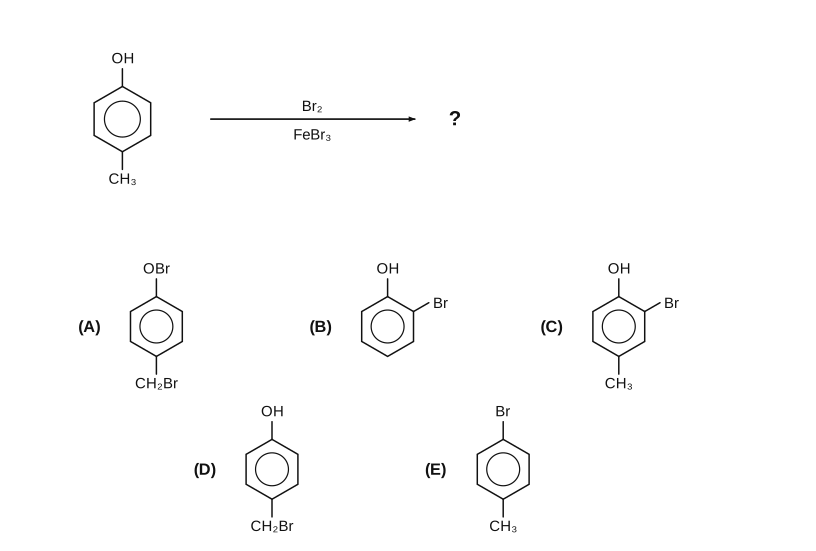
›Reveal solutionSolution
-OH activates and directs ortho/para. With the para position occupied by -CH3, electrophilic bromination goes ortho to the -OH, yielding 2-bromo-4-methylphenol.
p-Cresol is 4-methylphenol, with -OH and -CH3 para to each other. Both substituents are ortho/para directors, but the -OH group is a much stronger activator and controls the orientation. Its para position is already occupied by the methyl group, so electrophilic aromatic bromination (with Br2/FeBr3) occurs at the position ortho to the -OH. The major product is **2-bromo-4-methylphen …
- KEAM 2025Set pha-2025-0424A4 marksMCQQ.When chlorobenzene is treated with acetyl chloride in the presence of anhydrous AlCl3 , 4-Chloroacetophenone is formed as the major product. It is an example of (A) Nucleophilic substitution (B) Electrophilic substitution (C) Free radical substitution (D) Nucleophilic addition (E) Electrophilic addition
›Reveal solutionSolution
AlCl3 generates the acylium electrophile CH3CO+, which substitutes a ring hydrogen (para to Cl). This is electrophilic aromatic substitution.
CH3COCl+AlCl3→CH3CO++AlCl4−. The acylium ion attacks the electron-rich benzene ring of chlorobenzene at the para position (Cl is o,p-directing), for …
- KEAM 2024Set eng-2024-06084 marksMCQQ.An organic compound X (C6H6O) on reaction with zinc dust gives 'Y'. The product 'Y' reacts CH3COCl in presence of anhydrous AlCl3 to give 'Z' (C8H8O). The compounds X, Y and Z are respectively (A) benzaldehyde, benzene, methyl phenyl ketone (B) phenol, benzene, acetophenone (C) phenol, naphthalene, acetophenone (D) benzene, phenol, diphenyl ketone (E) cyclohexanol, cyclohexane, benzophenone
›Reveal solutionSolution
X = phenol, Y = benzene, Z = acetophenone: phenol is reduced by Zn dust to benzene, which undergoes Friedel–Crafts acylation to give acetophenone (C8H8O).
Identify X: C6H6O is phenol. Heating phenol with zinc dust reduces it (removes the –OH):
C6H5OH+Zn⟶C6H6+ZnO
so Y = benzene.
Benzene then undergoes Friedel–Crafts acylation with acetyl chloride and anhydrous AlCl3: …
🎓Unlock everything free for 14 days
- ✓Full step-by-step solutions
- ✓Concept-first explanations
- ✓Methods, shortcuts & mistakes
- ✓PYQ mapping + timed mock tests
Full access for 14 days. No credit card required.