Q.Assertion: Acetanilide is less basic than aniline.
Reason: Acetylation of aniline results in decrease of electron density on nitrogen.
🔒You're viewing a preview — the full solution, concept, methods & PYQ mapping are locked.
🔒 Start your 10-day free trial to unlock the full solution →Concept understanding — Inductive Effect on Acidity
Inductive Effect on Acidity – From Intuition to Precision
Imagine you are holding a rope tied to a heavy box. If you pull the rope, the box moves toward you. Now imagine the rope is made of rubber bands — the pull still reaches the box, but it gets weaker the farther away you are. That is exactly how the inductive effect works inside a molecule.
The Core Intuition
An acid donates a proton (H+). After it does, the remaining part (the conjugate base) carries a negative charge. The stability of that negative charge determines how willing the molecule is to give up the proton. More stable conjugate base → stronger acid.
Now, some atoms or groups are electron-withdrawing — they pull electron density toward themselves through the sigma bonds. If such a group is attached near the acidic proton, it pulls some electron density away from the negative charge on the conjugate base. That spreads out (delocalises) the negative charge, making the conjugate base more stable. The acid becomes stronger.
Conversely, electron-donating groups push electron density toward the negative charge, concentrating it and making the conjugate base less stable. The acid becomes weaker.
The inductive effect operates through sigma bonds only. It does not involve pi bonds or resonance. It is a permanent, through-bond polarisation.
The Precise Statement
Inductive effect on acidity: The acidity of a compound increases with the presence of electron-withdrawing groups (EWGs) near the acidic site, and decreases with electron-donating groups (EDGs). The effect is strongest when the group is closest to the acidic proton, and diminishes rapidly with distance.
Mathematically, for a series of substituted carboxylic acids:
R-COOHwhere R = substituent
The acid dissociation constant Ka changes as:
- If R is electron-withdrawing (e.g., −Cl, −NO2, −CF3): Ka increases → stronger acid.
- If R is electron-donating (e.g., −CH3, −C2H5): Ka decreases → weaker acid.
Why Distance Matters
The inductive effect falls off with distance because sigma bonds are localised. Each bond attenuates the effect by roughly a factor of 2–3. For example, compare:
| Compound | pKa | Explanation |
|---|---|---|
| CH3COOH | 4.76 | Reference (no EWG) |
| ClCH2COOH | 2.86 | Cl withdraws through one bond |
| Cl2CHCOOH | 1.29 | Two Cl atoms, stronger withdrawal |
| Cl3CCOOH | 0.65 | Three Cl atoms, strongest withdrawal |
| CH3CH2COOH | 4.87 | Ethyl group is electron-donating (slightly weaker acid) |
Notice: ClCH2COOH is about 100 times stronger than acetic acid (ΔpKa≈1.9). But if the Cl is moved further away:
| Compound | pKa |
|---|---|
| ClCH2CH2COOH | 4.08 |
| ClCH2CH2CH2COOH | 4.52 |
The effect fades as the chlorine moves farther from the carboxyl group. …
Why this formula?
Inductive Effect on Acidity: Why It Works
The inductive effect is a through-bond electron displacement caused by differences in electronegativity. When we ask why it affects acidity, we must first understand what acidity means at the molecular level.
The Core Idea: Stabilising the Conjugate Base
Acidity is governed by the equilibrium:
HA⇌H++A−
The stronger the acid, the more it favours the right side. This happens when the conjugate base A− is more stable. The inductive effect directly influences this stability.
Why Electron-Withdrawing Groups (EWG) Increase Acidity
Consider a carboxylic acid with an electronegative atom (like Cl) attached to the carbon chain:
Cl−CH2−COOH
- The inductive pull: The Cl atom is more electronegative than carbon. It pulls electron density toward itself through the sigma bonds.
- Effect on the O–H bond: This electron withdrawal travels along the carbon chain, reducing electron density around the O–H bond. The bond becomes more polarised, making the H⁺ easier to remove.
- Stabilising the conjugate base: After losing H⁺, the negative charge on the carboxylate ion (RCOO−) is delocalised by resonance. But the inductive effect further stabilises this negative charge by pulling electron density away from the oxygen atoms. This makes the conjugate base less reactive (more stable), shifting equilibrium toward dissociation.
Key insight: The inductive effect doesn't just weaken the O–H bond — it stabilises the anion that forms after deprotonation.
The Quantitative Relationship: Hammett Equation
For substituted benzoic acids, the effect is quantified by the Hammett equation:
log(Ka0Ka)=σρ
Where:
- Ka = acid dissociation constant of substituted acid
- Ka0 = acid dissociation constant of unsubstituted benzoic acid
- σ = substituent constant (measures inductive + resonance effect)
- ρ = reaction constant (sensitivity of the reaction to substituent effects)
Why This Formula Holds
The derivation comes from linear free-energy relationships:
- Free energy change: For any acid dissociation:
ΔG∘=−RTlnKa
- Effect of substituent: A substituent changes ΔG∘ by an amount proportional to its electronic effect:
Δ(ΔG∘)=−RTln(Ka0Ka)
-
Separability assumption: The total effect of a substituent on any reaction can be factored into:
- A substituent-specific term (σ) — how strongly it pulls/pushes electrons
- A reaction-specific term (ρ) — how sensitive the reaction is to electronic effects
-
Empirical validation: Hammett found that for meta and para substituted benzoic acids, plotting log(Ka/Ka0) against σ gives a straight line. This confirms the additive nature of inductive effects.
The Inductive Effect Constant (σI) …
Concept: Inductive effect and resonance — the acetyl group withdraws electron density from nitrogen via resonance, reducing its ability to donate a lone pair.
Reasoning:
- In aniline, the nitrogen lone pair is partially delocalised into the benzene ring, making it moderately basic.
- Acetylation introduces a carbonyl group directly attached to nitrogen. The lone pair on nitrogen now participates in resonance with the C=O group, forming an amide. …
Acetylation converts the lone pair on aniline’s nitrogen into an amide, where resonance with the carbonyl group delocalises the electrons. This drastically reduces electron density on nitrogen, making acetanilide far less basic than aniline. The reason correctly explains the assertion.
The question tests your understanding of how resonance (not just inductive effect) governs basicity in nitrogen compounds. Basicity depends on how readily the nitrogen atom can donate its lone pair to a proton. Anything that delocalises or withdraws that lone pair makes the compound less basic.
Aniline’s nitrogen lone pair is already partially delocalised into the benzene ring — that’s why aniline is a weaker base than aliphatic amines like methylamine. But acetylation takes this delocalisation much further.
-
What acetylation does structurally
Acetylation of aniline replaces one hydrogen on the –NH₂ group with a –COCH₃ group, forming acetanilide (C₆H₅–NH–COCH₃). The nitrogen is now part of an amide functional group.
-
The key resonance effect
In an amide, the nitrogen lone pair is in conjugation with the carbonyl (C=O) group. The major resonance contributor places a positive charge on nitrogen and a negative charge on oxygen:
C6H5–NH–C∣∣O–CH3⟷C6H5–N+H=C−(O−)–CH3
This resonance is so strong that the C–N bond in amides has partial double-bond character. The lone pair is no longer available for protonation — it’s tied up in the π-system.
-
Comparing electron density on nitrogen
In aniline, the lone pair is only partially delocalised into the benzene ring (the ring is less electron-withdrawing than a carbonyl). In acetanilide, the carbonyl group is a much stronger electron-withdrawing group via resonance, so the electron density on nitrogen is drastically reduced.
Basicity order: aniline (pKₐ of conjugate acid ≈ 4.6) >> acetanilide (pKₐ ≈ −0.5)
The difference is about 5 orders of magnitude — acetanilide is essentially non-basic in water.
-
Why the reason is correct and is the explanation …
Method: Inductive Effect & Resonance Analysis for Basicity
Step 1 – Identify the functional groups involved
- Aniline: C6H5NH2 — nitrogen has a lone pair available for protonation.
- Acetanilide: C6H5NHCOCH3 — nitrogen is attached to a carbonyl group (−COCH3).
Step 2 – Analyse electron density on nitrogen in each compound
- In aniline, the lone pair on nitrogen is partially delocalised into the benzene ring (resonance), but nitrogen still retains significant electron density.
- In acetanilide, the lone pair on nitrogen is strongly delocalised into the adjacent carbonyl group (C=O) via resonance:
CX6HX5−NH−C(=O)−CHX3CX6HX5−NX+=C(−O−)−CHX3
This resonance withdraws electron density from nitrogen.
Step 3 – Relate electron density to basicity
- Basicity depends on the availability of the lone pair to accept a proton (H+).
- Lower electron density on nitrogen → less basic.
- Acetanilide has less electron density on nitrogen than aniline → acetanilide is less basic.
Step 4 – Evaluate Assertion and Reason …
Here’s a breakdown of the common mistakes students make on this exact question, along with how to avoid each.
🧠 The Correct Answer First
Option (D) is correct.
- Assertion: Acetanilide is less basic than aniline. ✓
- Reason: Acetylation of aniline results in decrease of electron density on nitrogen. ✓
- Reason is the correct explanation of the assertion.
✗ Mistake 1: Confusing “Basic” with “Acidic”
What students do wrong:
They see “inductive effect” and immediately think about acidity trends (e.g., electron-withdrawing groups increase acidity). Here, the question is about basicity — the ability of nitrogen to donate its lone pair.
How to avoid:
- Basicity depends on electron density on nitrogen. More electron density → more basic.
- Acidity depends on stability of conjugate base.
- Always check: Is the question about donating or accepting a proton?
✗ Mistake 2: Forgetting the Role of Resonance in Acetanilide
What students do wrong:
They only consider the inductive effect of the acetyl group (−COCH3) and think it’s a weak electron-withdrawing group, so the effect on basicity is small.
The truth:
The acetyl group causes resonance withdrawal — the lone pair on nitrogen is delocalized into the carbonyl group:
Ph−NH−COCHX3Ph−NHX+=C(O−)CHX3
This dramatically reduces electron density on nitrogen, making acetanilide much less basic than aniline.
How to avoid:
- Always check if resonance (mesomeric effect) is possible.
- For amides (like acetanilide), resonance dominates over inductive effects.
✗ Mistake 3: Misreading the Reason Statement
What students do wrong:
They think the reason says “acetylation increases electron density” or they misinterpret “decrease in electron density” as a wrong statement.
How to avoid:
- Read the reason carefully: “Acetylation of aniline results in decrease of electron density on nitrogen.”
- This is factually correct — the acetyl group pulls electron density away via resonance and induction.
- Don’t overthink: if both assertion and reason are true and linked, pick (D).
✗ Mistake 4: Thinking the Reason is Not the Correct Explanation
What students do wrong: …
Showing the 12 most recent of 17 on this concept.
- KEAM 2026Set eng-2026-04174 marksMCQQ.Which of the following carboxylic acid has the highest pKa value? (A) O2N-CH2-COOH (B) F-CH2-COOH (C) HCOOH (D) CN-CH2COOH (E) Cl-CH2COOH
›Reveal solutionSolution
Among the choices, HCOOH lacks any strong electron-withdrawing α-substituent, so its conjugate base is least stabilised — it is the weakest acid and thus has the highest pKa.
Acidity of a carboxylic acid rises (i.e. pKa falls) when an electron-withdrawing group near the −COOH stabilises the carboxylate anion.
- O2N−CH2COOH: strong −I nitro, very low pKa. …
- KEAM 2026Set eng-2026-04224 marksMCQQ.The decreasing order of acid strength of the following is (A) FCH2COOH>NCCH2COOH>NO2CH2COOH>ClCH2COOH (B) CNCH2COOH>O2NCH2COOH>FCH2COOH>ClCH2COOH (C) NO2CH2COOH>NCCH2COOH>FCH2COOH>ClCH2COOH (D) NO2CH2COOH>FCH2COOH>NCCH2COOH>ClCH2COOH (E) ClCH2COOH>FCH2COOH>NCCH2COOH>NO2CH2COOH
›Reveal solutionSolution
The stronger the electron-withdrawing substituent, the more acidic the acetic acid: NO2>CN>F>Cl, giving O2NCH2COOH>NCCH2COOH>FCH2COOH>ClCH2COOH. …
- KEAM 2025Set eng-2025-04254 marksMCQQ.Which of the following acid is highly acidic? (A) Fluoroacetic acid (B) Formic acid (C) Dichloroacetic acid (D) Benzoic acid (E) Acetic acid.
›Reveal solutionSolution
Acid strength increases with electron-withdrawing substituents that stabilise the conjugate base. Two chlorines in dichloroacetic acid (pKa≈1.3) make it the most acidic here.
Comparing approximate pKa values (lower = more acidic):
- Dichloroacetic acid: ~1.3 (two −I Cl atoms) — strongest.
- Fluoroacetic acid: ~2.6.
- Formic acid: ~3.75.
- Benzoic acid: ~4.2.
- Acetic acid: ~4.76. …
- KEAM 2025Set eng-2025-04294 marksMCQQ.Which of the following is the strongest acid? (A) FCH2COOH (B) CF3COOH (C) NC-CH2COOH (D) Br-CH2COOH (E) CH3COOH
›Reveal solutionSolution
Acid strength rises with the electron-withdrawing power near the -COOH. Three fluorines in CF3COOH give the strongest -I effect and the most stabilised conjugate base, so it is the strongest acid.
Substituted acetic acids become stronger as the electron-withdrawing (–I) effect of the substituent increases, because a more stabilised carboxylate anion means a more readily released proton.
- CH3COOH (E): electron-donating methyl, weakest acid. …
- KEAM 2025Set pha-2025-0424F4 marksMCQQ.Which of the following is the weakest acid? (A) FCH2COOH (B) NC−CH2COOH (C) Cl3C−COOH (D) O2N−CH2COOH (E) Cl2CHCOOH
›Reveal solutionSolution
Acidity rises with electron-withdrawing power near the –COOH. Comparing the groups, mono-fluoro on one α-C (FCH2COOH, pKa≈2.6) is the least acid-strengthening, so it is the weakest acid.
Comparison (approximate pKa):
- Cl3C−COOH (trichloroacetic): ≈0.7 — three Cl directly on the carbonyl carbon, strongest.
- Cl2CH−COOH (dichloroacetic): ≈1.3.
- O2N−CH2COOH (nitroacetic): ≈1.7.
- NC−CH2COOH (cyanoacetic): ≈2.5. …
- JEE Main 2025Set 2025-04-03-s14 marksMCQQ.The least acidic compound, among the following is: (A) [drawn structure: benzene ring with EtO- and -OH substituents, meta to each other] (B) [drawn structure: benzene ring with -SO3H substituent] (C) [drawn structure: a chain with a -COOH group, pentanoic-acid-type skeletal structure] (D) [drawn structure: EtO2C-C≡C-H, ethyl propiolate] (A) B (B) D (C) A (D) C
›Reveal solutionSolution
Comparing the four acidic sites - sulfonic acid O-H, carboxylic acid O-H, phenolic O-H, and terminal alkyne C-H - the alkyne C-H (structure D, ethyl propiolate) is by far the weakest acid; since answer choice (B) is mapped to structure D in this question's labelling, the least acidic compound is choice (B).
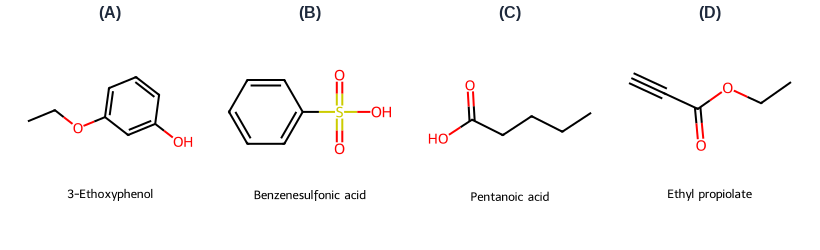
Four acidic compounds: 3-ethoxyphenol, benzenesulfonic acid, pentanoic acid, and ethyl propiolate Acid strength here is governed by how stable/delocalised the conjugate base is after loss of the acidic proton:
- Structure B - benzenesulfonic acid (Ar−SO3H): the sulfonate anion ArSO3− spreads its negative charge over three equivalent, highly electronegative oxygens via strong resonance plus inductive stabilisation from the S(=O)2 group - one of the strongest common organic acids, pKa≈−2.
- Structure C - pentanoic acid (a simple carboxylic acid): the carboxylate anion is resonance-stabilised over two oxygens, giving a moderate acid, pKa≈4.8. …
- KEAM 2024Set eng-2024-06054 marksMCQQ.Which of the following carboxylic acid has the highest pKa? (A) ethanoic acid (B) chloroethanoic acid (C) fluoroethanoic acid (D) dichloroethanoic acid (E) triflouroethanoic acid
›Reveal solutionSolution
Electron-withdrawing halogens stabilise the carboxylate and lower pKa; unsubstituted ethanoic acid, having none, has the highest pKa.
Acid strength increases (pKa decreases) with the number and electronegativity of α-halogen substituents, which stabilise the conjugate base by the −I effect. The order of increasing acidity is roughly: …
- KEAM 2024Set eng-2024-06064 marksMCQQ.The order of decreasing acid strength of carboxylic acids is (A) FCH2COOH>ClCH2COOH>NO2CH2COOH>CNCH2COOH (B) CNCH2COOH>FCH2COOH>NO2CH2COOH>ClCH2COOH (C) NO2CH2COOH>FCH2COOH>ClCH2COOH>CNCH2COOH (D) FCH2COOH>NO2CH2COOH>ClCH2COOH>CNCH2COOH (E) NO2CH2COOH>CNCH2COOH>FCH2COOH>ClCH2COOH
›Reveal solutionSolution
Acidity follows the electron-withdrawing (−I) strength: NO2>CN>F>Cl, matching the pKa order.
Electron-withdrawing substituents on the α-carbon stabilise the carboxylate and raise acidity. The experimental pKa values are: nitroacetic ≈1.68, cyanoacetic ≈2.47, fluoroacetic ≈2.59, chloroacetic ≈2.87. Lower …
- KEAM 2024Set eng-2024-06094 marksMCQQ.The increasing order of acid strength of the following carboxylic acids is(i) (CH3)3C-COOH(ii) (CH3)2CH-COOH(iii) CH3CH2COOH (A)(ii) <(i) <(iii) (B)(i) <(iii) <(ii) (C)(ii) <(iii) <(i) (D)(iii) <(ii) <(i) (E)(i) <(ii) < (iii)
›Reveal solutionSolution
Electron-donating alkyl groups destabilise the carboxylate; more branching = weaker acid.
The acids are (i) (CH3)3C-COOH (tert-butyl, three methyls), (ii) (CH3)2CH-COOH (isopropyl, two methyls), (iii) CH3CH2-COOH (ethyl, one methyl on the α-carbon side). Electron-donating (+I) alkyl groups intensify the negative charge on the carboxylate anion, destabilising it and …
- JEE Main 2024Set 2024-01-29-s24 marksMCQQ.The ascending acidity order of the following H atoms is: [FIGURE] (A) C < D < B < A (B) A < B < C < D (C) A < B < D < C (D) D < C < B < A
›Reveal solutionSolution
Compare C–H acidities via carbanion stability, which follows the hybridization of the carbon: sp>sp2>sp3, and among sp3 carbons, less substituted is more acidic.
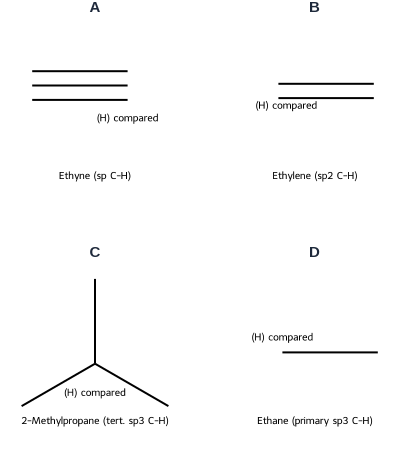
Four hydrocarbon fragments A-D are shown, each with one marked (circled) hydrogen whose acidity is being compared: A = HC\equivC-H (cir... - Deprotonation gives a carbanion; greater s-character stabilizes the lone pair, so sp carbon (A, terminal alkyne) is most acidic. …
- JEE Main 2024Set 2024-01-31-s14 marksMCQQ.Given below are two statements: One is labelled as Assertion A and the other is labelled as Reason R: Assertion A: pKa value of phenol is 10.0 while that of ethanol is 15.9. Reason R: Ethanol is stronger acid than phenol. In the light of the above statements, choose the correct answer from the options given below: (A) A is true but R is false. (B) A is false but R is true. (C) Both A and R are true and R is the correct explanation of A. (D) Both A and R are true but R is NOT the correct explanation of A.
›Reveal solutionSolution
Lower pKa = stronger acid; phenol (10.0) is stronger than ethanol (15.9), so R is false while A is true.
Tetrahydropyran (O in ring) bearing a CHO and a ring OH, reacted with PhMgX then NH4Cl to give the secondary alcohol PhCH(OH)- attached to t - Assertion A gives pKa values: phenol 10.0, ethanol 15.9 — these are the accepted values, so A is true. …
- JEE Main 2024Set 2024-01-30-s24 marksMCQQ.Given below are two statements: one is labelled as Assertion A and the other is labelled as Reason R. Assertion A: H2Te is more acidic than H2S. Reason R: Bond dissociation enthalpy of H2Te is lower than H2S. In light of the above statements, choose the most appropriate answer from the options given below: (A) Both A and R are true but R is NOT the correct explanation of A. (B) Both A and R are true and R is the correct explanation of A. (C) A is false but R is true. (D) A is true but R is false.
›Reveal solutionSolution
Down a group the H–E bond weakens, so acid strength increases; the lower bond dissociation enthalpy of H2Te explains its greater acidity.
-
Acidity of hydrides H2E increases down the group: H2O<H2S<H2Se<H2Te.
-
The H–Te bond is longer and weaker than H–S, so its bond dissociation enthalpy is lower, making proton release easier. …
-
🎓Unlock everything free for 10 days
- ✓Full step-by-step solutions
- ✓Concept-first explanations
- ✓Methods, shortcuts & mistakes
- ✓PYQ mapping + timed mock tests
Full access for 10 days. No credit card required.