Q.(a) Resistivity of a conductor depends upon
You're viewing a preview — the full solution, concept, methods & PYQ mapping are locked.
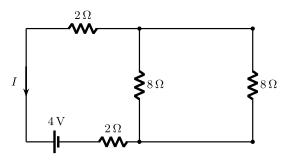
Start your 14-day free trial to unlock the full solution →(a) Resistivity is an intrinsic material property (depends on material and temperature, not on geometry). (b) The given network reduces to 2Ω+2Ω in series with two 8Ω resistors in parallel, giving I = 0.5 A. (c) A potentiometer compares two emfs by measuring the balancing length for each cell in turn.
(a) What resistivity depends on
Resistivity (ρ) is an intrinsic property of the material itself (and its temperature) — it does not depend on the conductor's length or cross-sectional area; those factors instead determine the total resistance via . So the correct choice is (i) its material.
(b) Current in the circuit
The circuit has a 4 V cell in series with a 2Ω resistor (bottom branch) and another 2Ω resistor (top-left, carrying the total current I), and these lead into two 8Ω resistors connected in parallel with each other, completing the loop back to the cell.
Equivalent resistance of the two parallel 8Ω resistors:
This parallel combination is in series with the two 2Ω resistors:
By Ohm's law, the current drawn from the 4 V cell:
(c) Comparing emfs of two cells using a potentiometer
A potentiometer wire AB carries a steady current from a driver battery, setting up a uniform potential gradient (k, volts per unit length) along its length. To compare the emfs and of two cells:
…
Unlock everything free for 14 days
- Full step-by-step solutions
- Concept-first explanations
- Methods, shortcuts & mistakes
- PYQ mapping + timed mock tests
Full access for 14 days. No credit card required.