Question of 42
Q.(a) Write the working principle of a potentiometer.
(1)
(b) With a neat circuit diagram and with relevant equations explain how the emf of two cells are compared using a potentiometer. (4)
Kerala DhseKerala DHSE Plus Two Board 2021Subjective· 5mImportance★★★★★
0% · 0/42 Questions
You're viewing a preview — the full solution, concept, methods & PYQ mapping are locked.
Start your 14-day free trial to unlock the full solution →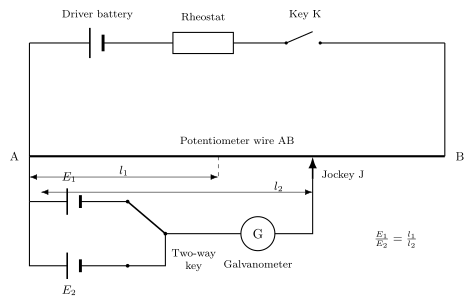
A potentiometer works because a uniform wire carrying a steady current has a potential drop proportional to length; balancing two cells in turn against this wire and comparing their null-point lengths gives the ratio of their emfs.
- Working principle: When a constant current flows through a wire of uniform cross-section (and uniform resistivity), the potential drop across any length of the wire is directly proportional to that length. This is because , and since , , are all constant along the wire, . This proportionality (a constant "potential gradient" k = V/l, in volts per unit length) is the working principle of the potentiometer.
- Comparing the emf of two cells: Circuit: A long, uniform potentiometer wire AB is connected in series with a driver battery (of emf greater than either cell to be compared), a rheostat, and a key , forming the primary circuit which sets up a steady current and hence a uniform potential gradient k along AB. The two cells and (whose emfs are to be compared) are connected, through a two-way key (so only one is in circuit at a time) and a galvanometer, between terminal A and a sliding jockey J that touches the wire. Procedure: …
Unlock everything free for 14 days
- Full step-by-step solutions
- Concept-first explanations
- Methods, shortcuts & mistakes
- PYQ mapping + timed mock tests
Full access for 14 days. No credit card required.