Q.Distinguish between Ohmic and non-ohmic substances; explain with the help of example.
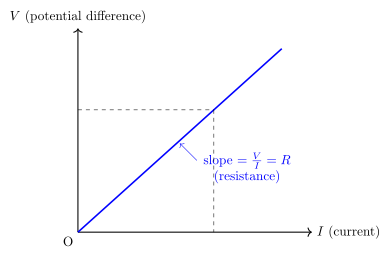
An OHMIC (linear) substance or device obeys Ohm's law: its current-vs-potential-difference (I-V) graph is a straight line passing through the origin (Fig. 11.4, section 11.6), so its resistance is a single CONSTANT value, independent of how much voltage or current is applied (as long as its physical state, e.g. temperature, is unchanged). Most simple metallic conductors -- for instance a plain resistor made of nichrome wire (as in MCQ ii above) -- are ohmic to a very good approximation over a wide operating range.
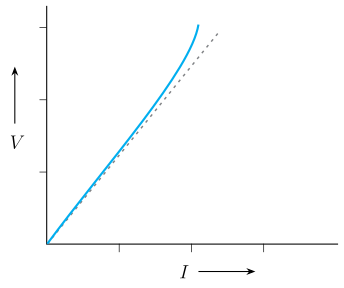
A NON-OHMIC substance or device does NOT obey Ohm's law: its I-V graph is curved rather than straight (Fig. 11.5), so the ratio changes depending on the operating point, and its resistance must instead be defined locally as the tangent slope (Eq. 11.16). Examples given in section 11.6 include liquid electrolytes, vacuum tubes, junction diodes, and thermistors. A junction diode is a particularly clear everyday example: it conducts current easily in one direction (forward bias) but hardly at all in the reverse direction, so its I-V graph is strongly asymmetric and curved, nowhere close to a straight line through the origin -- unmistakably non-ohmic behaviour. [!ANSWER] Ohmic: linear I-V, constant R (metals, e.g. nichrome); Non-ohmic: non-linear I-V, R varies with V/I (junction diodes, thermistors, electrolytes, vacuum tubes).
Unlock everything free for 14 days
- Full step-by-step solutions
- Concept-first explanations
- Methods, shortcuts & mistakes
- PYQ mapping + timed mock tests
Full access for 14 days. No credit card required.