Q.Which of the following is an ohmic conductor? (A) transistor (B) vacuum tube (C) electrolyte (D) nichrome wire
Concept understanding — Ohmic and Non-Ohmic Conductors
A device is called OHMIC (or linear) if its current-vs-potential-difference (I-V) graph is a straight line passing through the origin, meaning its resistance R=V/I is one single constant value regardless of how much voltage or current is applied. Simple metallic conductors -- for instance nichrome wire, used in heating elements -- are ohmic to a very good approximation over a wide range of operating conditions.
A device is called NON-OHMIC if its I-V graph is curved rather than straight, so no single constant resistance describes it everywhere; instead its resistance must be defined LOCALLY, as the tangent slope of the curve at the operating point of interest, R=dV/dI. Liquid electrolytes, vacuum tubes, junction diodes, and thermistors are all standard non-ohmic examples -- a junction diode, for instance, conducts easily in one direction but barely at all in reverse, giving a strongly asymmetric, curved I-V characteristic that is nowhere close to Ohm's-law behaviour.
[!TLDR] Nichrome wire is a metallic conductor with a linear I-V graph and constant resistance, unlike the other listed devices. [!ANSWER] (D) nichrome wire
An ohmic conductor is one whose current-voltage (I-V) graph is a straight line through the origin, i.e. its resistance stays constant regardless of the applied voltage or current (section 11.6). Transistors, vacuum tubes, and electrolytes are all classic NON-ohmic devices -- a transistor's I-V characteristic is strongly non-linear (that non-linearity is exactly what makes it useful for amplification/switching), a vacuum tube's current depends non-linearly on the applied voltage (space-charge-limited conduction), and an electrolyte's conduction depends on ion concentration and can show non-linear behaviour, especially near the electrodes. Nichrome wire, being a simple metallic alloy resistor, follows Ohm's law closely over a wide range of applied voltages, making it the ohmic device in this list. [!ANSWER] (D) nichrome wire
Recall that ohmic devices have a linear I-V graph through the origin (constant R); metallic resistors like nichrome are the standard ohmic example, while transistors, vacuum tubes and electrolytes are standard non-ohmic examples.
Assuming all electronic components are automatically non-ohmic, or forgetting that a simple resistive metal wire (like nichrome, used in heating elements) is exactly the everyday example of an ohmic conductor.
- CBSE 2026Set A1 markMCQQ.Ohm's law does not apply, when (A) temperature changes (B) temperature is constant (C) potential difference changes (D) none of these
›Reveal solutionSolution
Ohm's law requires physical conditions (especially temperature) to stay constant.
Ohm's law, V=IR with R constant, is obeyed only when the conductor's physical state — chiefly its temperature — remains unchanged. If temperature changes, the resistivity (and hence R) changes, so the current is no longer proportional to the applied voltage and the V–I graph departs from a straight line.
Thus Ohm's law does not apply when the temperature changes.
✓Final answer(A) temperature changes.
- CBSE 2025Set IMPROVEMENT1 markQ.Write the name of a device that does not follow Ohm's law.
›Reveal solutionSolution
A p-n junction diode is a non-ohmic device — its current does not vary linearly with the applied voltage.
Ohm's law states that V∝I (i.e. V/I = constant = resistance) for a conductor kept at constant physical conditions. A p-n junction diode does not obey this: in forward bias, the current stays negligibly small until a threshold (knee) voltage is crossed, after which it rises very steeply and non-linearly with voltage; in reverse bias, the current stays almost constant (a small saturation current) over a wide range of reverse voltage. Since the V–I graph of a diode is not a straight line through the origin, it is a non-ohmic device.
✓Final answerA p-n junction (semiconductor) diode is a device that does not follow Ohm's law.
- CBSE 2025Set JS1 markQ.Draw the graph between Voltage (V) and Current (I) for ohmic and non-ohmic resistances.
›Reveal solutionSolution
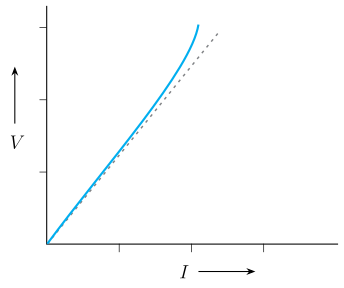
Figure — Fig 3.5 plots V versus I with a dashed straight line (linear Ohm's law = ohmic behaviour) and a solid curved l Ohmic conductor → straight line through origin (V∝I); non-ohmic conductor → curved V–I graph.
Concept. A conductor is ohmic if it obeys Ohm's law, V=IR with R constant, so V is directly proportional to I. A non-ohmic conductor (e.g. a semiconductor diode, a filament lamp, a gas discharge tube) does not obey Ohm's law — R changes with the applied voltage or current.
Graph (description).
- Ohmic: a straight line passing through the origin; its constant slope IV=R.
- Non-ohmic: a curve (not a straight line); the slope dIdV varies from point to point.
V | / (ohmic: straight line) | / | / __-- (non-ohmic: curve) | / __-- |/__-- +-----------------> I✓Final answerOhmic: straight line through the origin (V∝I, constant R). Non-ohmic: curved graph (slope, i.e. resistance, changes with current).
- CBSE 2025Set D1 markMCQQ.The graph between voltage V of a conductor and current I is a straight line, which makes an angle θ with y-axis ( which represents I ). The resistance of the conductor will be (A) tan θ (B) cot θ (C) sin θ (D) cos θ
›Reveal solutionSolution
Resistance R = tan θ when the V–I line makes angle θ with the I-axis.
Here the y-axis represents current I and the x-axis represents voltage V. The graph is a straight line making angle θ with the y-axis.
The slope of the line measured from the x-axis is (90° − θ), so
slope=dVdI=tan(90∘−θ)=cotθ
Since slope dI/dV = 1/R (conductance),
R=cotθ1=tanθ
✓Final answer(A) tan θ.
- CBSE 2025Set ANNUAL1 markQ.Is Ohm's law true for all conductors?
›Reveal solutionSolution
Ohm's law (V proportional to I, i.e. a constant V/I ratio) is an empirical rule that holds for metallic conductors at constant temperature, but many important conducting devices are non-ohmic and do not obey it.
Ohm's law states that the current through a conductor is directly proportional to the potential difference across it, provided physical conditions like temperature remain constant - giving a constant resistance R = V/I.
This holds reasonably well for pure metallic conductors (like a nichrome or copper wire) at constant temperature. However, many devices show a non-linear V-I relationship and are therefore called non-ohmic: examples include semiconductor diodes (current flows easily only one way), transistors, electrolytes/gas discharge tubes, and even a metal filament bulb once self-heating significantly changes its resistance with current.
So Ohm's law is a special case, not a universal law of nature - it applies only to certain (ohmic) conductors under limited conditions.
✓Final answerNo, Ohm's law is not true for all conductors - only ohmic conductors (e.g. metals at constant temperature) obey V = IR with constant R; diodes, transistors, and electrolytes are common non-ohmic exceptions.
- CBSE 2024Set ANNUAL1 markQ.Draw a graph between potential difference (V) and current (I) according to Ohm's law.
›Reveal solutionSolution
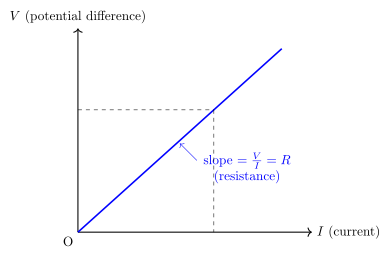
Figure — A single straight line passing through the origin on axes with potential difference V on the y-axis Ohm's law states V = IR at constant temperature, so a V-I graph is a straight line through the origin.
Ohm's law states that for a conductor at constant physical conditions (especially constant temperature), the potential difference V across it is directly proportional to the current I flowing through it:
V=IR
where R (the resistance) is constant. Plotting V (y-axis) against I (x-axis) therefore gives a straight line passing through the origin, whose slope equals the resistance R. (Equivalently, plotting I against V gives a straight line through the origin with slope 1/R.)
✓Final answerA straight line through the origin; its slope gives the resistance R.
- CBSE 2024Set ANNUAL1 markMCQQ.A potential difference of 12 V is applied across the ends of a 4 kΩ resistor. How much current is flowing through it ?(a) 3 mA(b) 3 A(c) 4 A(d) 48 mA
›Reveal solutionSolution
Apply Ohm's law, I = V/R.
Given: V = 12 V, R = 4 kΩ = 4 × 10³ Ω.
By Ohm's law:
I = V/R = 12 / (4 × 10³) = 3 × 10⁻³ A
✓Final answerI = 3 × 10⁻³ A = 3 mA — option (a).
- CBSE 2023Set ANNUAL1 markQ.The SI unit of resistance is ________.
›Reveal solutionSolution
Resistance R = V/I, so its SI unit is volt per ampere, called the ohm (Ω).
Resistance is defined through Ohm's law: R=IV, where V is the potential difference across a conductor (in volt) and I is the current through it (in ampere).
So the unit of resistance is volt/ampere, which is given the special name ohm, symbol Ω. A conductor has a resistance of 1 ohm if a potential difference of 1 volt across it drives a current of 1 ampere through it.
✓Final answerSI unit of resistance = ohm (Ω) = volt/ampere.
- CBSE 2022Set M1 markQ.State ohm's law.
›Reveal solutionSolution
At constant temperature, V ∝ I, so V = IR.
Ohm's law states that the electric current I flowing through a conductor is directly proportional to the potential difference V applied across its ends, provided the physical conditions such as temperature remain constant.
V∝I⇒V=IR
where the constant of proportionality R is the resistance of the conductor.
✓Final answerAt constant temperature V∝I, i.e. V=IR.
- CBSE 2022Set HE2171 markMCQQ.The Ohmic resistance is:(i) Transistor(ii) Copper wire(iii) Light emitting diode(iv) Junction diode
›Reveal solutionSolution
An ohmic resistance is one whose V-I graph is a straight line through the origin; copper wire (a metal) is ohmic.
Ohm's law states that for a conductor at constant temperature, V=IR, i.e. the V-I graph is a straight line through the origin with slope R. Metals such as copper obey this law over a wide range of currents because their resistance depends only on temperature, not on the direction or magnitude of current.
A transistor, a light emitting diode, and a junction diode are all non-ohmic (non-linear) devices — their V-I curves are not straight lines, and current does not flow equally in both directions (in the diode/LED case) or the relation is far from linear (transistor).
✓Final answer(ii) Copper wire.
- CBSE 2019Set ANNUAL1 markQ.How much current flows through a 2 kΩ resistor when a potential difference of 4 V is applied across its ends?
›Reveal solutionSolution
By Ohm's law, I=V/R=4 V/2000Ω=2 mA.
Given V=4 V, R=2 kΩ=2000 Ω.
I=RV=20004=2×10⁻³ A=2 mA
✓Final answerI=2 mA.
- CBSE 2018Set ANNUAL1 markMCQQ.How much current is flowing through a 1 kΩ resistor when a potential difference of 2V is applied across its ends? (A) 2 μA (B) 2 mA (C) 2 A (D) 1 A
›Reveal solutionSolution
By Ohm's law, I=V/R=2 V/1000 Ω=2 mA.
Given V=2 V and R=1 kΩ=1000 Ω. By Ohm's law,
I=RV=10002=2×10⁻³ A=2 mA
✓Final answerI=2 mA — option (B).
🎓Unlock everything free for 14 days
- ✓Full step-by-step solutions
- ✓Concept-first explanations
- ✓Methods, shortcuts & mistakes
- ✓PYQ mapping + timed mock tests
Full access for 14 days. No credit card required.