Biology · Ch 9 — Control and Co-ordination
Nervous System in Hydra
Nervous System in Hydra
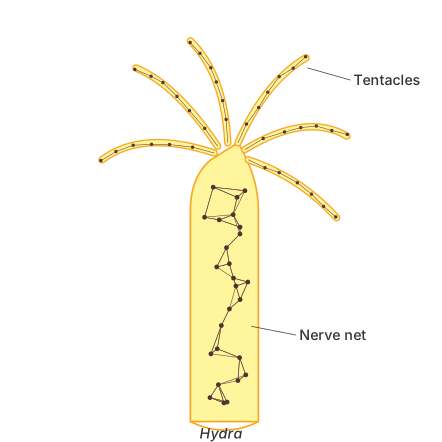
Hydra, a cnidarian, has the most primitive form of true nervous system known -- a diffused nervous system. It is built from sensory cells and nerve cells (neurons), together with their fibres, scattered through the body rather than gathered into a brain or ganglion; connected to each other by synapses between their fibres, these scattered cells form a nerve net. There are actually two such nets, both lying in the mesoglea (the jelly-like middle layer) -- one oriented toward the epidermis and one toward the gastrodermis. Sensory cells are scattered over the body wall and tentacles, but Hydra has no dedicated sense organs, and its neurons have fibres but no separately identifiable sensory and motor nerves.
Drawn by us to help you understand the concept clearly, and verified to make sure it's accurate. For exams, practice from your textbook's own diagram.
What this figure shows. A diagram of Hydra's body wall showing scattered nerve cells interconnected by their fibres into a mesh-like nerve net running through the body and into the tentacles, illustrating that Hydra has no centralized brain or ganglion and that an impulse starting anywhere in this net can spread outward in every direction …
…