Chemistry · Ch 11 — Alcohols, Phenols and Ethers
Mono, di, tri and polyhydric compounds
Mono, di, tri and polyhydric compounds
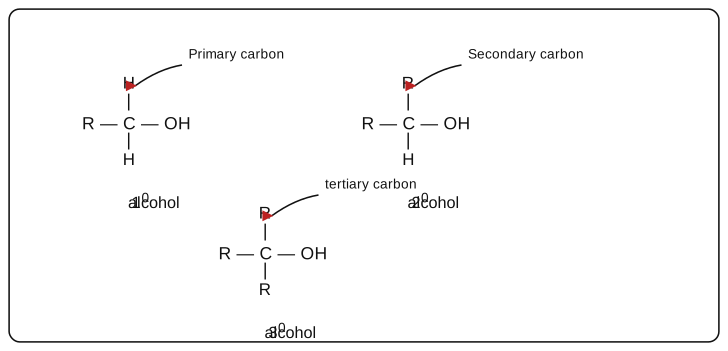
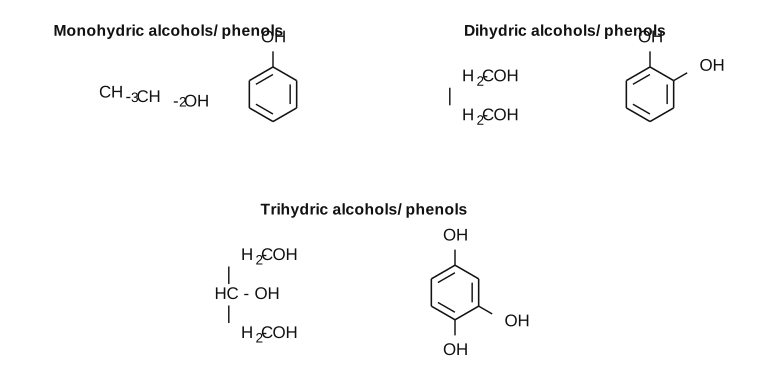
Monohydric, dihydric, trihydric and polyhydric compounds are alcohols/phenols bearing one, two, three, or more -OH groups respectively in their molecule: ethanol (CH3-CH2-OH) is monohydric, ethylene glycol (HOCH2-CH2OH) is dihydric, and glycerol (HOCH2-CH(OH)-CH2OH) is trihydric; the same one/two/three-OH classification applies equally to phenols (e.g. catechol, resorcinol and hydroquinone are dihydric phenols; phloroglucinol and pyrogallol are trihydric phenols). Within the monohydric alcohols, those whose -OH is bonded to an ORDINARY sp3-hybridised carbon (an alkyl-group carbon, not part of any C=C) are classified by how many other carbon-containing groups are attached to that same carbon: primary (1 degree, one R group plus two H's, pattern R-CH2-OH), secondary (2 degree, two R groups plus one H, pattern R2CH-OH), or tertiary (3 degree, three R groups and no H, pattern R3C-OH). A separate, structurally distinct class is the vinylic alcohol, in which the -OH group sits on an sp2-hybridised carbon that is itself part of a carbon-carbon double bond, the simplest example being vinyl alcohol, CH2=CH-OH. Independently of the primary/secondary/tertiary classification, any sp3 alcohol whose -OH-bearing carbon is ALSO directly bonded to a C=C double bond is further called allylic (it may still be primary, secondary or tertiary), and any sp3 alcohol whose -OH-bearing carbon is instead bonded to …
Drawn by us to help you understand the concept clearly, and verified to make sure it's accurate. For exams, practice from your textbook's own diagram.
What this figure shows. Three generic sp3-carbon-OH structures side by side, each drawn as a central carbon bonded to an -OH group: the primary (1 degree) alcohol carbon carries one R group plus two H's (R-CH2-OH pattern); the secondary (2 degree) alcohol carbon carries two R groups plus one H (R2CH-OH pattern); and the tertiary (3 degree) alcohol carbon carries three R groups and no H (R3C-OH pattern). The figure is the book's reference legend for classifying any alcohol's -OH-bearing carbon by how many other carbon-containing groups (ver …
Drawn by us to help you understand the concept clearly, and verified to make sure it's accurate. For exams, practice from your textbook's own diagram.
What this figure shows. Three worked structural examples illustrating the mono/di/trihydric classification: a monohydric alcohol/phenol bearing one -OH group (ethanol, CH3-CH2-OH, is the printed monohydric alcohol example); a dihydric compound bearing two -OH groups on adjacent or non-adjacent carbons (ethylene glycol pattern, HOCH2-CH2OH); and a trihydric compound bearing three -OH groups, one on each of three carbons of a three-carbon chain (glycerol pattern, HOCH2-CH(OH)-CH2OH). A dihydric and trihydric phenol pattern (benzene ring bearing two or three -OH groups respectively) is shown alongside the aliphatic examples to make clear th …