Q.Which is the best reagent for carrying out following conversion ?
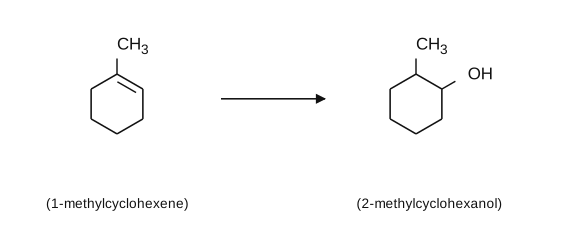
B. Conc. H₂SO₄, H₂O
C. H₂/Pd
D. B₂H₆, H₂O₂-NaOH
Concept understanding — Preparation of Alcohols
Alcohols are made by five general routes. Hydrolysis of an alkyl halide with aqueous alkali or moist silver oxide gives the alcohol directly. Acid-catalysed (Markovnikov) hydration of an alkene, via an alkyl hydrogen sulfate intermediate, places -OH on the MORE substituted carbon (through a three-step mechanism: protonation of the alkene to a carbocation, nucleophilic attack by water, then deprotonation). Hydroboration-oxidation instead places -OH on the LESS substituted carbon (anti-Markovnikov): B2H6 adds to the alkene with boron on the less hindered carbon, and H2O2/NaOH then replaces C-B with C-OH at the same position, without carbocation rearrangement. Reduction of carbonyl compounds gives aldehydes-to-primary-alcohols and ketones-to-secondary-alcohols with H2/Ni or LiAlH4; carboxylic acids need the stronger LiAlH4 (or, industrially, esterification then catalytic hydrogenation) to give primary alcohols; LiAlH4 uniquely leaves an isolated C=C bond untouched. Addition of a Grignard reagent to a carbonyl compound, then acidic hydrolysis, gives a primary alcohol from formaldehyde, a secondary alcohol from any other aldehyde, or a tertiary alcohol from a ketone; an epoxide plus a Grignard reagent likewise gives a primary alcohol.
Unlock everything free for 14 days
- Full step-by-step solutions
- Concept-first explanations
- Methods, shortcuts & mistakes
- PYQ mapping + timed mock tests
Full access for 14 days. No credit card required.