Chemistry · Ch 6 — Chemical Kinetics
Orientation of reactant molecules
Orientation of reactant molecules
The requirement for a successful collision described above is sufficient for reactions involving simple molecules (or ions), however not for those involving complex molecules.
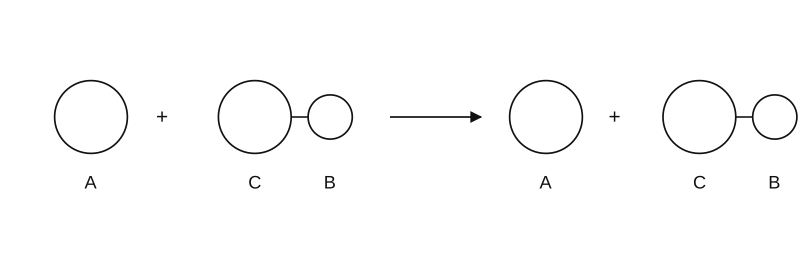
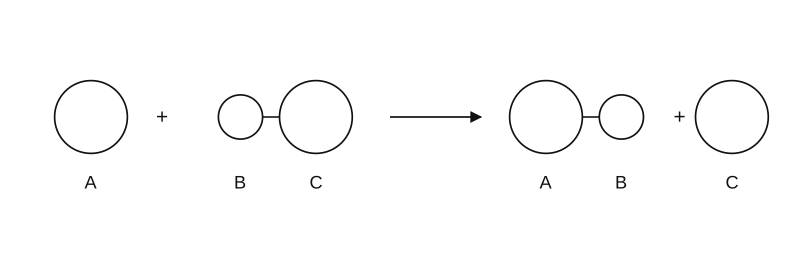
Besides the above considerations, the colliding molecules must have the proper orientation: the molecules need to be so oriented relative to each other that the reacting groups approach closely.
Consider,
i. The collision of A with C approaching toward A would not lead to reaction.
Drawn by us to help you understand the concept clearly, and verified to make sure it's accurate. For exams, practice from your textbook's own diagram.
What this drawing shows (the book prints it without a caption). Atom A approaches molecule C - B from the C side — the wrong end, since the new bond must form between A and B. The right-hand side of the arrow is identical to the left: the molecules simply collide and separate, and **no re …
No reaction will take place: the reactant molecules would collide and separate, owing to the improper orientation of C - B.
ii.
Drawn by us to help you understand the concept clearly, and verified to make sure it's accurate. For exams, practice from your textbook's own diagram.
What this drawing shows (uncaptioned in the book). Here the orientation is right: A approaches the B end. During the collision the new A - B bond develops while the B - C bond breaks, giving the products A - B and free C. Only the fraction of collisions with this proper orientation …
…