Chemistry · Ch 6 — Chemical Kinetics
Potential energy barrier
Potential energy barrier
Consider again the reaction
During the course of a collision the new bond A - B develops; at the same time the bond C - B breaks. A configuration in which all the three atoms are weakly connected together is called the activated complex:
To attain the configuration , the atoms need to gain energy, which comes from the kinetic energy of the colliding molecules.
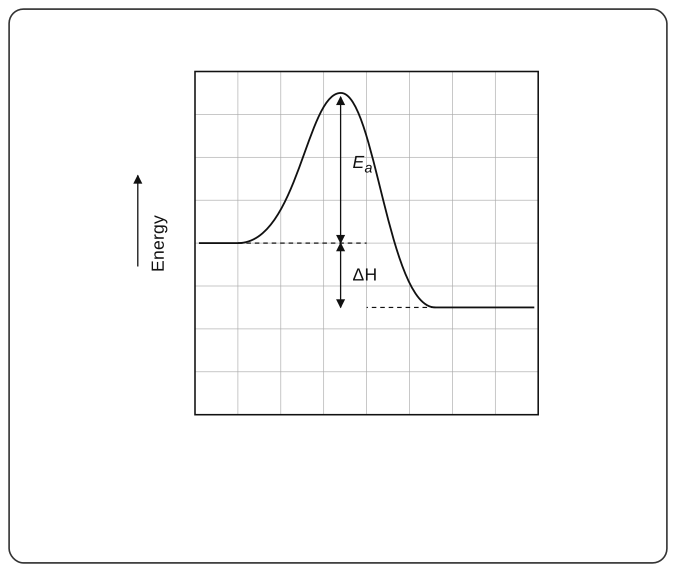
The energy barrier between reactants and products is shown in Fig. 6.7. The reactant molecules need to climb up and overcome this barrier before they get converted to products. The height of the barrier is called the activation energy (). Thus, the reactant molecules transform to products only if they possess energy equal to or greater than such activation energy. A fraction of molecules that possess energy greater than is given by .
Drawn by us to help you understand the concept clearly, and verified to make sure it's accurate. For exams, practice from your textbook's own diagram.
What this figure shows. Moving left to right, the Energy curve starts at the reactant level, climbs to a single peak — the activated complex — and falls to the product level, here drawn below the reactant level (an exothermic profile). The double-headed arrow from the reactant level up to the peak is the activation energy — the minimum energy the colliding molecules must possess. The arrow from the reactant level down to the product level is , the net en …
As a result, only a few collisions lead to products. The number of successful collisions is further reduced by the orientation requirement already discussed.
Do you know ? …