Q.Calculate the standard enthalpy of : N2H4(g)+H2(g)→2NH3(g) if ΔH0(N-H) = 389 kJ mol−1, ΔH0(H-H) = 435 kJ mol−1, ΔH0 (N-N) = 159 kJ mol−1
Concept understanding — Bond Enthalpy
Bond Enthalpy: The Energy Cost of Breaking a Bond
Think of a chemical bond as a spring holding two atoms together. To pull the atoms apart, you have to do work — you have to put energy in. That energy, per mole of bonds broken, is the bond enthalpy. The stronger the bond, the more energy you need to supply, and the larger the bond enthalpy.
The intuition is simple: breaking bonds costs energy; forming bonds releases energy. A reaction is exothermic if the energy released in forming new bonds is greater than the energy consumed in breaking old ones.
The Precise Definition
Bond enthalpy (symbol: ΔHbond or B.E.) is defined under a specific set of conditions:
The average enthalpy change when one mole of a particular covalent bond is broken, with all species in the gaseous state.
Three key points are packed into that sentence:
- One mole of bonds — we measure the energy for Avogadro's number of bonds, not just one.
- Gaseous state — the atoms or molecules must be in the gas phase. This removes complications from intermolecular forces (like hydrogen bonding in liquid water) and lets us isolate the bond energy itself.
- Average — in a molecule like water (H2O), the two O–H bonds are not identical in energy. The first O–H bond in H2O requires about 502 kJ/mol to break, but the second (in the remaining OH radical) requires about 427 kJ/mol. So we report the average bond enthalpy for O–H: roughly 464 kJ/mol.
Bond enthalpy is always positive — it is the energy absorbed to break a bond. Bond formation releases the same amount of energy (negative enthalpy change).
How It's Used: Estimating Reaction Enthalpies
You can estimate the enthalpy change of a reaction (ΔHrxn) using bond enthalpies:
ΔHrxn=∑(bond enthalpies of bonds broken)−∑(bond enthalpies of bonds formed)
The logic: you put energy in to break bonds (positive), and you get energy out when bonds form (negative). So:
ΔHrxn=Energy in−Energy out
This method gives an estimate, not an exact value. Bond enthalpies are averages taken from many different molecules, so they don't account for the exact molecular environment. For precise work, use standard enthalpies of formation.
Example: Combustion of Methane
Consider: CH4(g)+2O2(g)→CO2(g)+2H2O(g)
Bonds broken (energy in):
- 4 C–H bonds: 4×413=1652 kJ/mol
- 2 O=O bonds: 2×498=996 kJ/mol
- Total in: 1652+996=2648 kJ/mol
Bonds formed (energy out):
- 2 C=O bonds: 2×799=1598 kJ/mol
- 4 O–H bonds: 4×464=1856 kJ/mol
- Total out: 1598+1856=3454 kJ/mol
ΔHrxn=2648−3454=−806 kJ/mol
The negative sign tells you the reaction is exothermic — more energy is released in forming bonds than was consumed in breaking them.
In exam problems, you'll often be given a table of average bond enthalpies. Always check the state of the products — if water is liquid, you need to account for the enthalpy of vaporization separately, because bond enthalpy data assumes gaseous water.
Why "Average" Matters
Bond enthalpy is not a universal constant. The C–H bond in methane is not identical to the C–H bond in ethane or benzene. The exact energy depends on the other atoms attached — the bond's environment. But for quick estimates, the average values work well enough.
The table below shows some common average bond enthalpies (in kJ/mol):
| Bond | Average Bond Enthalpy (kJ/mol) |
|---|---|
| H–H | 436 |
| C–H | 413 |
| O–H | 464 |
| C=O | 799 |
| O=O | 498 |
| N≡N | 945 |
Notice the triple bond in N2: 945 kJ/mol. That's enormous — it's why nitrogen gas is so unreactive.
The Bottom Line
Bond enthalpy is the average energy required to break one mole of a specific covalent bond in the gas phase. It lets you estimate reaction enthalpies by comparing the energy cost of breaking bonds with the energy gain from forming new ones. The stronger the bond, the larger the bond enthalpy, and the more stable the molecule.
Bond Enthalpy is a numerical-heavy concept from the Thermodynamics chapter of NCERT/CBSE Class 11 Chemistry, and it shows up often in "Bond Enthalpy numericals", "Bond Enthalpy important questions", and "Bond Enthalpy class 11 chemistry" searches because board exams, JEE Main, and NEET all test it through calculation-based problems.
Count bonds from the structures: the reactants carry 4 N-H + 1 N-N (in H2N-NH2) + 1 H-H, the products carry 6 N-H (in 2 NH3); reaction enthalpy = reactant bonds broken minus product bonds formed (Eq. 4.31).
ΔrH0=159+435−2×389=−184 kJ -- digit-for-digit the textbook's printed final.
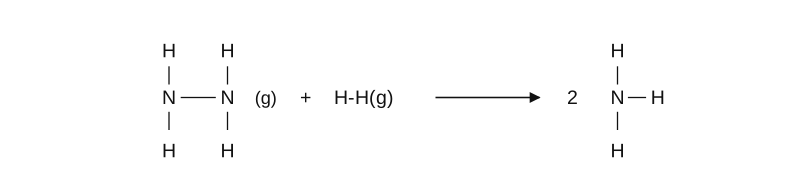
[4ΔH0(N−H)+ΔH0(N−N)+ΔH0(H−H)]−6ΔH0(N−H)=159+435−778=−184 kJ.
Step 1. Draw the structures (the book prints this as an explicit structural equation): hydrazine H2N-NH2 contains 4 N-H bonds and 1 N-N bond; H2 contains 1 H-H bond; each NH3 contains 3 N-H bonds, so the two product molecules carry 6 N-H bonds.
Step 2. By the bond-enthalpy relation (reactant bonds broken minus product bonds formed): ΔrH0=[4ΔH0(N−H)+ΔH0(N−N)+ΔH0(H−H)]−[6ΔH0(N−H)].
Step 3. Four of the product's six N-H bonds cancel against the reactant's four: ΔrH0=ΔH0(N−N)+ΔH0(H−H)−2ΔH0(N−H).
Step 4. ΔrH0=159+435−2×389=594−778=−184 kJ.
ΔrH0=−184 kJ -- digit-for-digit the textbook's printed final.
Draw every molecule's structure, count each bond type on both sides, and apply Delta_r H0 = sum of reactant bond enthalpies minus sum of product bond enthalpies.
- Miscounting hydrazine's bonds (it has 4 N-H and 1 N-N, not 2 N-H).
- Applying products-minus-reactants: for BOND enthalpies the convention is reactants (broken) minus products (formed).
- Forgetting that 2 NH3 means 6 N-H bonds, not 3.
- CBSE 2020Set ANNUAL2 marksQ.Mention two conditions for the formation of ionic bond.
›Reveal solutionSolution
[!TLDR]
- Low ionization enthalpy of the metal (electropositive) atom so it readily loses electron(s) to form a cation. 2. High (negative) electron gain enthalpy of the non-metal atom so it readily gains electron(s) to form an anion, together with a high lattice enthalpy of the resulting ionic compound.
Method
Ionic bond formation is favoured when one atom can easily lose electrons (low IE1) and the other can easily gain electrons (favourable electron gain enthalpy), and the resulting oppositely charged ions are stabilised by a large lattice enthalpy on packing into a crystal lattice.
[!ANSWER]
- Low ionization enthalpy of the metal (electropositive) atom so it readily loses electron(s) to form a cation. 2. High (negative) electron gain enthalpy of the non-metal atom so it readily gains electron(s) to form an anion, together with a high lattice enthalpy of the resulting ionic compound.
- CBSE 2019Set ANNUAL2 marksQ.What is Bond enthalpy? Arrange H2, N2 and O2 in increasing order of Bond enthalpy. [1+1=2] OR Draw the structure of SF6 and SF4 on the basis of VSEPR theory. [1+1=2]
›Reveal solutionSolution
Bond enthalpy is the energy needed to break one mole of a bond in the gas phase; since N2 has a triple bond, O2 a double bond and H2 a single bond, bond enthalpy increases as H2 < O2 < N2.
Definition: Bond enthalpy (or bond dissociation enthalpy) is the amount of energy required to break one mole of a particular type of bond between two atoms in a gaseous molecule, producing the separated gaseous atoms/fragments. It is always a positive quantity (bond breaking absorbs energy) and is a measure of bond strength — the higher the bond enthalpy, the stronger the bond.
Comparing H2, N2 and O2:
- H2 has a single H-H bond: bond enthalpy ≈ 436 kJ/mol.
- O2 has a double O=O bond: bond enthalpy ≈ 498 kJ/mol.
- N2 has a triple N≡N bond: bond enthalpy ≈ 946 kJ/mol — one of the strongest bonds known, which is why N2 gas is so chemically unreactive at room temperature.
Since bond order (number of shared electron pairs) increases from single (H2) to double (O2) to triple (N2), and a higher bond order means a stronger, shorter bond, bond enthalpy increases in the same order:
H2 < O2 < N2
✓Final answerBond enthalpy is the energy required to break one mole of a given covalent bond between two atoms in the gaseous state to give the separated gaseous atoms. Increasing order of bond enthalpy for the three molecules: H2 < O2 < N2 (approximately 436 kJ/mol < 498 kJ/mol < 946 kJ/mol).
🎓Unlock everything free for 14 days
- ✓Full step-by-step solutions
- ✓Concept-first explanations
- ✓Methods, shortcuts & mistakes
- ✓PYQ mapping + timed mock tests
Full access for 14 days. No credit card required.