Chemistry · Ch 9 — Coordination Compounds
Introduction
Introduction
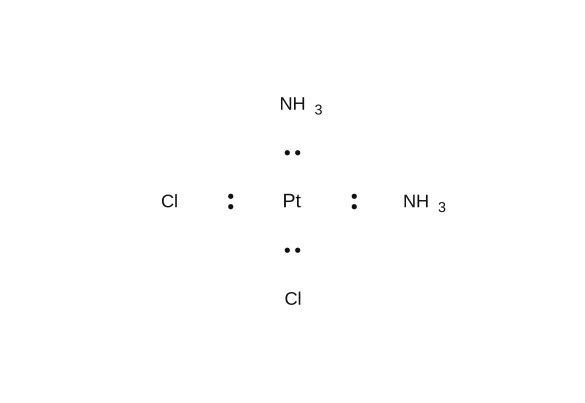
A coordination compound consists of a central metal atom or ion surrounded by ions or molecules called ligands. Cisplatin, Pt(NH3)2Cl2, a well-known chemotherapy drug, is the chapter's opening example: its central platinum ion is directly surrounded by two ammonia molecules and two chloride ions. The species around the central metal are called ligands, and they are linked to the metal through coordinate bonds rather than ordinary shared bonds -- a coordinate bond forms when ONE side (the ligand) contributes both electrons of the shared pair, while the metal ion contributes none. This is conventionally drawn as an arrow, , with the arrowhead pointing toward the electron acceptor. The central metal atom or ion is usually electron-deficient and so acts as the electron-pair acceptor, while the ligands, carrying lone pairs to donate, act as electron-pair donors. In cisplatin, the two ammonia molecules and the two chloride ligands each use a lone pair of electrons to form a coordinate bond with the Pt(II) centre. Because one species is always donating an electron pair and the other always accepting it, the whole process of complex formation can be looked at through the lens of Lewis acid-base chemistry: the ligands, as electron-pair donors, are behaving as Lewis bases, while the central metal ion, as the electron-pair acceptor, is behaving as a Lewis acid. This acid-base framing recurs throughout the chapter, for instance when explaining why some ligands bind more strongly than others (chapter 9.8, stability) and why certain donor atoms are described as 'strong field' (chapter 9.9, bonding theories).
Drawn by us to help you understand the concept clearly, and verified to make sure it's accurate. For exams, practice from your textbook's own diagram.
What this figure shows. A square planar platinum(II) complex, the geometry expected for a four-coordinate d8 metal ion. The central Pt2+ ion sits at the centre of a square with four ligands at the corners: two NH3 molecules and two Cl- ions. In the cisplatin (cis) form specifically, the two identical NH3 ligands occupy adjacent (90 degree) corners of the square and the two Cl- ligands occupy the other two adjacent corners, so each NH3 has one NH3 and one Cl neighbour on either side. Each NH3 nitrogen and each Cl- ion donates a lone pair of electrons to platinum, forming four Pt-N and Pt-Cl coordinate bonds directed toward the corners of the square.
9.1: Cisplatin, Pt(NH3)2Cl2.