Chemistry · Ch 9 — Coordination Compounds
Isomerism in coordination compounds
Isomerism in coordination compounds
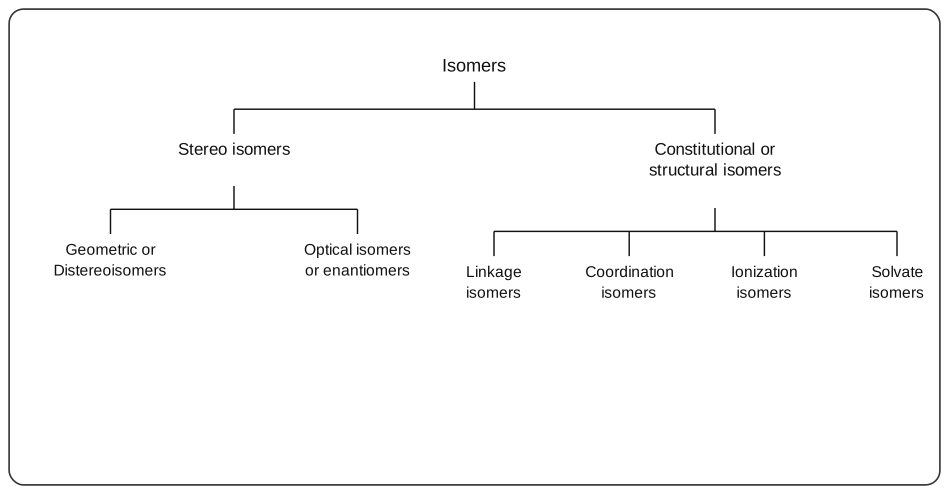
Isomers are different compounds that share exactly the same molecular formula but differ in their chemical reactivity and in physical properties such as colour, solubility, and melting point. Coordination-compound isomers fall into two broad families (Fig. 9.1). Stereoisomers (section 9.7.1) have IDENTICAL atom-to-atom connectivity -- the same set of bonds joining the same atoms -- but differ only in how those bonded atoms are arranged in three-dimensional space; this family splits further into geometric isomers (cis/trans, or diastereoisomers) and optical isomers (enantiomers). Constitutional or structural isomers (section 9.7.2) instead have genuinely DIFFERENT connectivity -- the atoms are linked together in a different pattern altogether, even though the overall formula matches; this fa …
Drawn by us to help you understand the concept clearly, and verified to make sure it's accurate. For exams, practice from your textbook's own diagram.
What this figure shows. A tree diagram with 'Isomers' at the top branching into two main classes: 'Stereo isomers' and 'Constitutional or structural isomers'. Stereo isomers further branch into 'Geometric or Diastereoisomers' and 'Optical isomers or enantiomers'. Constitutional/structural isomers further branch into four types: 'Linkage isomers', 'Ionization isomers', 'Coordination isomers' and 'Solva …