Chemistry · Ch 7 — Elements of Groups 16, 17 and 18
General characteristics of interhalogen compounds
General characteristics of interhalogen compounds
The book prints the number 7.12.1 twice — once for "Classification :" and again for this "General characteristics of interhalogen compounds" heading. To keep every section addressable, this second 7.12.1 is numbered 7.12.2 here; the title is the book's own.
1. The compound is considered as the halide of X. For example, in ClF the halogen having larger size is chlorine — it is more electropositive than F — and hence the interhalogen compound is named as chlorine monofluoride.
2. Interhalogen compounds have an even number of atoms: 2, 4, 6, 8. For example, has 4 atoms.
3. The properties of interhalogen compounds are generally intermediate between those of the halogens from which they are made.
4. The central halogen exhibits different oxidation states in different interhalogen compounds.
5. The number of X′ atoms in the compounds is always odd.
6. They are all diamagnetic.
Do you know ? compounds are more reactive than or . In the X-X′ bond, X′ is more electronegative than X, while in and both atoms have the same electronegativity; hence the X-X′ bond energy is less than the X-X or X′-X′ bond energy.
Table 7.10 : States of Interhalogen compounds at 25°C
| Formula | State |
|---|---|
| ClF | Colorless gas |
| BrF | Pale brown gas |
| BrCl | Gas |
| ICl | Ruby red solid (- form) / Brown red solid ( - form) |
| IBr | Black solid |
| Colorless gas | |
| Yellow green liquid | |
| Yellow powder | |
| Orange solid, dimerises to form (having Cl - bridges) | |
| Colorless gas at R. T. but solid below 77 K | |
| Colorless liquid | |
| Colorless liquid | |
| Colorless gas |
(The book's ICl cell prints "Brown red soid" for the -form — the intended word, restored above, is "solid".)
Methods of Preparation of Interhalogen compounds (the book collects these in a table)
| Method | ||
|---|---|---|
| 1. Direct combination | Both in equal volumes: ; ; | ; ; |
| 2. Reaction of halogen with interhalogen compounds. | ||
| Special reaction for ICl | ------- |
Do you know ? ICl in the liquid state undergoes autoionization, like water, to form a cation and an anion:
Some Properties of Interhalogen compounds (the book collects these in a table)
| Reaction/Property | |||
|---|---|---|---|
| 1 | Thermal stability | ClF > ICl > IBr > BrCl > BrF | |
| 2 | Hydrolysis gives oxoacids | ; | |
| 3 | Disproportionation/ Autoionisation | ; | |
| 4 | Fluorination (the book's row label prints "Flourination") | --------- | |
| 5 | Addition across olefins | (the book draws the product as a 2D structural formula, with I and Cl on the two carbons) |
Uses of interhalogen compound (the book collects these in a table)
| ICl is used to determine the iodine value of oils | For Preparation of polyhalides |
| As catalyst for oxidation of As(III) | As fluorinating agent |
| For Preparation of polyhalides | As nonaqueous solvent |
Table 7.11 Structures of some Interhalogen Compounds
| Formula | Name | Shape |
|---|---|---| …
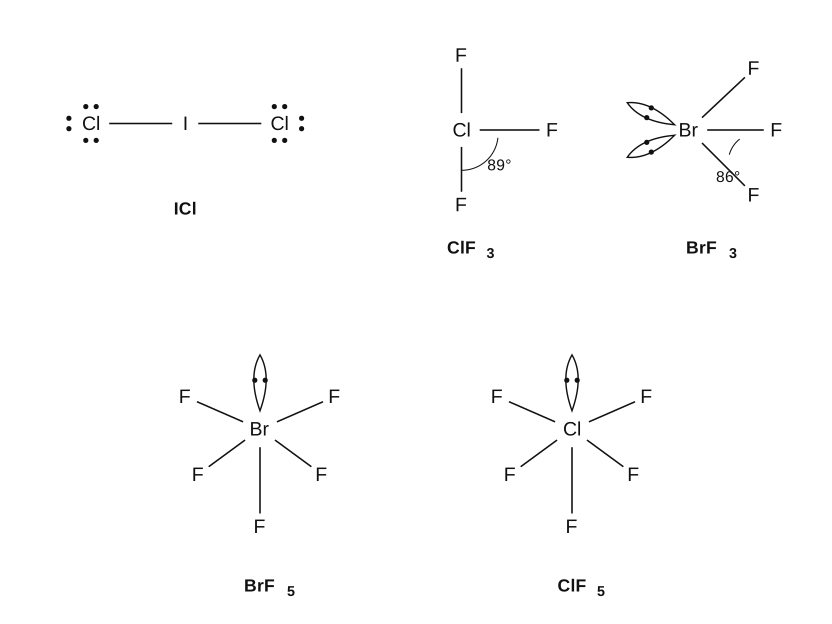
Drawn by us to help you understand the concept clearly, and verified to make sure it's accurate. For exams, practice from your textbook's own diagram.
The Structure column of Table 7.11, drawn out. and are bent T-shaped - the printed angles (89° and 86°, less than 90°) are the squeeze the two equatorial lone pairs put on the bonds. and are square pyramidal, with one lone-pair lobe completing the octahedral arrangement. …