Chemistry · Ch 7 — Elements of Groups 16, 17 and 18
Oxyfluorides of Xenon
Oxyfluorides of Xenon
Xenon forms the following oxyfluorides:
a. Preparation
i. Partial hydrolysis of xenon fluorides yields different oxyfluorides.
ii. Reaction of xenon oxyfluoride with , or hydrolysis, yields xenon dioxydifluoride.
Table 7.13 : Structure of Xenon Compounds
| Sr. No. | Formula | Oxidation state of Xe | Structure |
|---|---|---|---|
| 1. | +2 | Linear | |
| 2. | +4 | Square planar | |
| 3. | +6 | Distorted octahedral | |
| 4. | +6 | Trigonal pyramidal | |
| 5. | +6 | Square pyramidal (the book's cell prints "Square pyamidal") |
The book's Structure column draws each of these five molecules as a 3D ball-and-lobe model, with the lone pairs shown as shaded lobes — reproduced in the figure below.
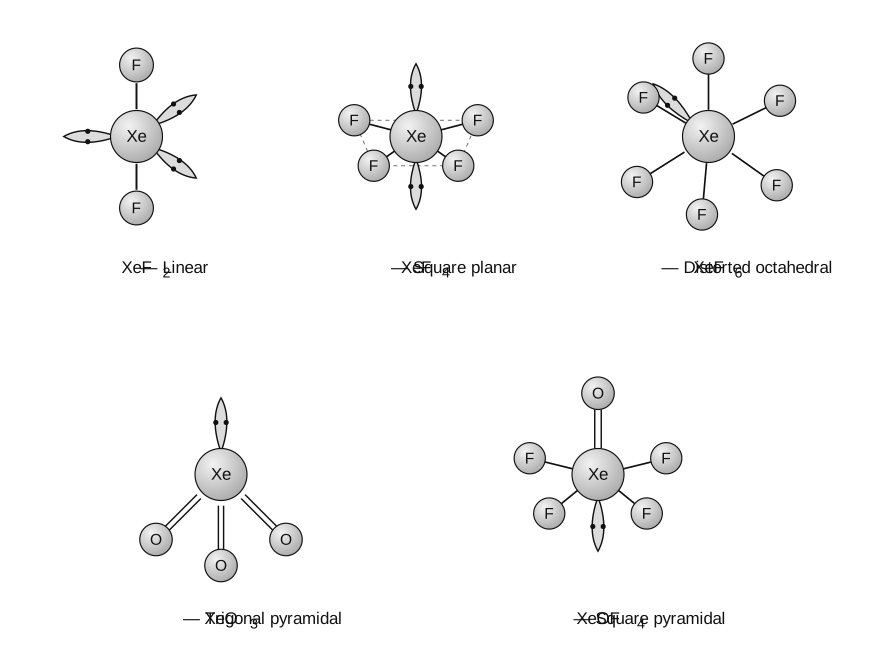
Drawn by us to help you understand the concept clearly, and verified to make sure it's accurate. For exams, practice from your textbook's own diagram.
The Structure column of Table 7.13, drawn out. Count bonds + lone pairs around Xe and each shape follows: - 2 bonds + 3 lone pairs = linear; - 4 + 2 = square planar; - 6 + 1 = distorted octahedral (the lone pair spoils the perfect octahedron); - 3 + 1 = trigonal pyramidal; - 5 (four F + one O on top) + 1 = **squa …
Table 7.14 : Uses of helium, neon and argon (the book closes the chapter's reading matter with this table of noble-gas uses)
| Element | Uses |
|---|---|
| Helium | i. A mixture of He and is used for artificial breathing of asthma patients. ii. A mixture of He and is used for respiration by sea divers. iii. For filling balloons, a mixture of helium (85%) and hydrogen (15 %) is used. iv. Helium is used for producing the inert atmosphere required for welding purposes and metallurgy of some metals. v. Liquid helium is used for producing the low temperatures required for research. vi. In low temperature gas thermometry, and for production of lasers. vii. Used to pressurize fuel tanks of liquid fueled rockets. viii. Used as shielding gas for arc welding. ix. In supersonic wind tunnels. x. The helium nucleus is used as a bombarding particle for disintegration of atoms. xi. Used for magnetic resonance imaging. |
| Neon | i. In neon discharge lamps and signs. These signs are visible from long distances, and also in mist or fog. ii. A mixture of Ne and He is used in certain protective electrical devices, such as voltage stabilizers and current rectifiers. iii. For production of lasers. iv. In fluorescent tubes. |