Chemistry · Ch 7 — Elements of Groups 16, 17 and 18
Ozone
Ozone
Ozone () is an allotrope of oxygen. Oxygen in the upper atmosphere absorbs energy in the form of ultra-violet light and changes to atomic oxygen, which combines with molecular oxygen to form :
The layer of ozone protects the earth's surface from harmful ultraviolet (U.V) radiations. Hence it is called the 'ozone umbrella'.
a. Preparation of Ozone : Ozone is prepared in the laboratory by passing a silent electric discharge through pure and dry oxygen, in an apparatus called an ozoniser. As the conversion of oxygen to ozone is only 10 %, the product is known as ozonised oxygen. It is an endothermic process.
b. Physical properties of ozone :
i. Pure ozone is a pale-blue gas, dark blue liquid and violet-black solid.
ii. Ozone has a characteristic smell. When inhaled in concentration above 100 ppm, it causes nausea and headache.
iii. It is diamagnetic in nature.
c. Chemical Properties :
i. Oxidising property : Ozone is a powerful oxidising agent, as it easily decomposes to liberate nascent oxygen ().
Ozone oxidises lead sulfide to lead sulfate, and iodide ions to iodine:
Ozone oxidises nitrogen oxide and gives nitrogen dioxide:
Hence the nitrogen oxide emitted from the exhaust systems of supersonic jet aeroplanes can bring forth depletion of the ozone layer in the upper atmosphere.
ii. Bleaching property : Ozone acts as a good bleaching agent due to its oxidising nature.
Ozone bleaches in the absence of moisture, so it is also known as dry bleach.
iii. Reducing property : Ozone reduces peroxides to oxides.
iv. Ozone depletion : Thinning of the ozone layer in the upper atmosphere is called ozone depletion.
- The ozone () layer in the upper atmosphere absorbs harmful UV radiations from the sun, thus protecting people on the earth.
- Depletion of the ozone layer in the upper atmosphere is caused by nitrogen oxide released from the exhaust systems of cars or supersonic jet aeroplanes:
- Depletion (thinning) of the ozone layer can also be caused by chlorofluoro carbons (freons), used in aerosols and refrigerators, and their subsequent escape into the atmosphere.
- The depletion of the ozone layer has been most pronounced in polar regions, especially over Antarctica.
- Ozone depletion is a major environmental problem because it increases the amount of ultraviolet (UV) radiation that reaches the earth's surface, thus causing an increase in the rate of skin cancer, eye cataracts, and genetic as well as immune system damage among people.
Do you know ? Ozone reacts with unsaturated compounds containing double bonds to form addition products called ozonides. Ozonides are decomposed by water or dilute acids to give aldehydes or ketones. This reaction is termed ozonolysis. …
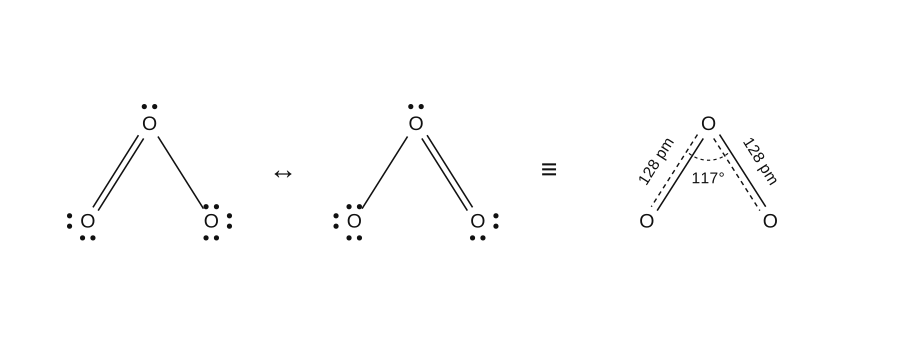
Drawn by us to help you understand the concept clearly, and verified to make sure it's accurate. For exams, practice from your textbook's own diagram.
What this drawing shows. Each canonical form puts the double bond on a different side of the bent molecule; neither alone is the real ozone. The real molecule - the resonance hybrid on the right - has two identical O-O bonds of 128 pm (between a double and a single bond in character) and a bond angle of about 117°. The double-headed arrow () is the resonance arrow - it never means …