Chemistry · Ch 7 — Elements of Groups 16, 17 and 18
Sulfur dioxide
Sulfur dioxide
a. Preparation :
i. From sulfur : Sulfur dioxide gas can be prepared by burning sulfur in air.
ii. From sulfite : In the laboratory, sulfur dioxide is prepared by treating an aqueous solution of sodium sulfite with dilute sulfuric acid.
iii. From sulfides : (Industrial method) Sulfur dioxide can be prepared by roasting zinc sulfide and iron pyrites.
b. Physical properties of
i. Sulfur dioxide is a colourless gas with a pungent smell.
ii. It is poisonous in nature.
iii. is highly soluble in water, and its solution in water is called sulfurous acid.
iv. It liquifies at room temperature under a pressure of 2 atm, and boils at 263 K.
c. Chemical Properties :
i. Reaction with : Sulfur dioxide reacts with chlorine in the presence of charcoal (catalyst) to form sulfuryl chloride.
ii. Reaction with : Sulfur dioxide is oxidised by dioxygen, in the presence of vanadium(V) oxide, to sulfur trioxide.
iii. Reaction with NaOH : Sulfur dioxide readily reacts with sodium hydroxide solution to form sodium sulfite.
iv. Reaction with : Sulfur dioxide reacts with sodium sulfite solution to form sodium hydrogen sulfite.
v. Reducing property : Sulfur dioxide acts as a reducing agent in the presence of moisture.
- Moist sulfur dioxide reduces ferric salts into ferrous salts.
- Moist sulfur dioxide decolourises acidified potassium permanganate (VII) solution.
- Moist sulfur dioxide reduces halogens to halogen acids.
…
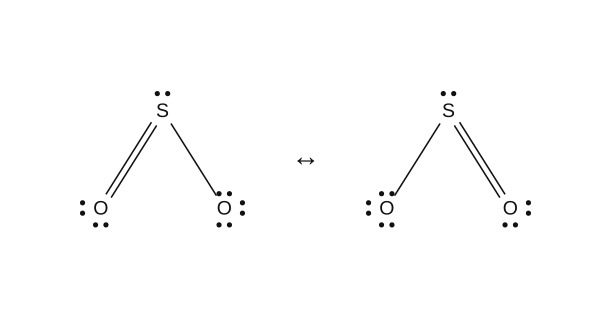
Drawn by us to help you understand the concept clearly, and verified to make sure it's accurate. For exams, practice from your textbook's own diagram.
What this drawing shows. is angular, with a lone pair on sulfur and an O-S-O angle of 119.5°. The two canonical forms swap which oxygen takes the double bond; the real molecule is the resonance hybrid with two equal S-O bonds. The section's text adds where the extra bonding comes from …