Chemistry · Ch 7 — Elements of Groups 16, 17 and 18
Sulfuric acid, H₂SO₄
Sulfuric acid, H₂SO₄
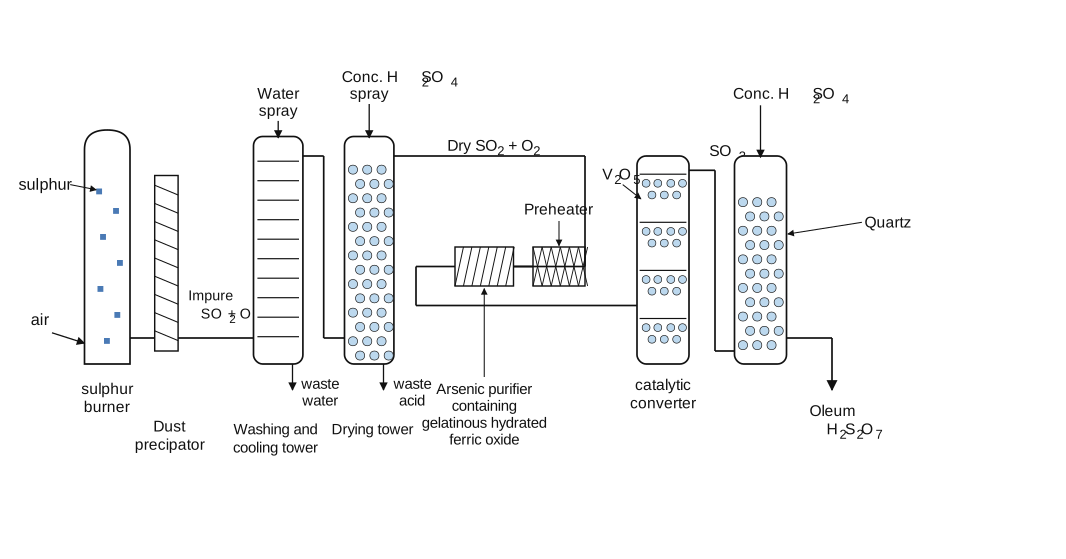
a. Preparation : Sulfuric acid is manufactured by the Contact process, which involves the following three steps:
i. Sulfur or sulfide ore (iron pyrites) on burning or roasting in air produces sulfur dioxide.
ii. Sulfur dioxide is oxidised catalytically with oxygen to sulfur trioxide, in the presence of catalyst.
The reaction is exothermic and reversible, and the forward reaction leads to a decrease in volume. Therefore low temperature (720 K) and high pressure (2 bar) are the favourable conditions for maximum yield of .
iii. Sulfur trioxide gas (from the catalytic converter) is absorbed in concentrated to produce oleum. Dilution of oleum with water gives sulfuric acid of the desired concentration.
The sulfuric acid obtained by the contact process is 96 - 98 % pure.
Drawn by us to help you understand the concept clearly, and verified to make sure it's accurate. For exams, practice from your textbook's own diagram.
Fig. 7.1 : Flow diagram for manufacture of Sulfuric acid. Follow the gas left to right: sulphur burns in air in the sulphur burner; the Impure SO₂ + O₂ passes the Dust precipator (the book's own spelling of precipitator), is scrubbed in the Washing and cooling tower (water spray in, waste water out) and dried in the Drying tower (conc. spray in, waste acid out); the Dry SO₂ + O₂ then crosses the Arsenic purifier (gelatinous hydrated ferric oxide) and the Preheater into the catalytic converter, whose trays hold the catalyst; the formed is absorbed in the quartz-packed tower fed with conc. , leaving as Oleum . …
b. Physical properties of :
i. Sulfuric acid is a colourless, dense, oily liquid.
ii. It has a density (specific gravity) of 1.84 g/cm³ at 298 K.
iii. It freezes at 283 K and boils at 611 K.
iv. It is highly corrosive and produces severe burns on the skin.
Do you know ? Sulfuric acid dissolves in water with the evolution of a large quantity of heat. Hence care must be taken while preparing a solution of sulfuric acid from concentrated sulfuric acid: concentrated must be added slowly to water, with constant stirring, keeping the beaker in a water bath.
c. Chemical Properties :
i. Acidic Property : Sulfuric acid ionises in aqueous solution in two steps.
The greater value of () means that is largely dissociated into and ions. Thus is a strong acid.
ii. Reaction with metals and nonmetals (oxidising property) : Metals and nonmetals both are oxidised by hot, concentrated sulfuric acid, which itself gets reduced to .
The oxidizing properties of sulfuric acid depend on its concentration and temperature. In dilute solutions at room temperature, behaves like HCl, oxidizing metals that stand above hydrogen in the e.m.f. series: . Hot, concentrated is a better oxidizing agent — it oxidises metals like copper.
iii. Dehydrating property : Concentrated sulfuric acid is a strong dehydrating agent. Sulfuric acid removes water from sugar and carbohydrates; the carbon left behind is called sugar charcoal, and the process is called charring.
iv. Reaction with salts : Concentrated sulfuric acid decomposes the salts of more volatile acids to the corresponding acid. e.g. …