Chemistry · Ch 16 — Green Chemistry and Nanochemistry
History of Nanotechnology
History of Nanotechnology
Nanomaterials have actually been produced and used by humans for hundreds of years, well before anyone understood or described them as 'nanostructured' -- the scientific understanding of certain traditional materials as being nanostructured is comparatively very recent, made possible only once sufficiently advanced, sophisticated instruments were developed that could actually reveal information at the nanoscale (the instruments covered in Section 16.7.3-16.7.4). Four historical examples illustrate this. (a) The beautiful ruby-red colour seen in some ancient glass paintings comes from gold and silver nanoparticles trapped within the glass matrix -- the same colour-shift phenomenon described for gold in Section 16.6.1, being exploited (without the artisans who made it understanding why) centuries before anyone had a scientific vocabulary for nanoparticles. (b) The decorative glaze or metallic film known as lustre, found on some medieval pottery, is likewise due to certain spherical metallic nanoparticles embedded in the glaze. (c) Carbon black, a nanostructured material discovered around 1900, is used in car tyres to increase tyre life; carbon nanotubes, made of graphite sheets with nanosized diameters, are related nanostructured carbon materials and have the highest strength of the materials mentioned in this section. (d) Fumed silica, a component used in silicone rubber, coatings, sealants and adhesives, is also a nanostructured material. The 'Do you know?' box accompanying this section adds two further historical milestones: the term 'nanotechnology' itself was defined by Professor Norio Taniguchi of Tokyo Science University in 1974, and the invention of the scanning tunnelling microscope (STM) in 1980 led directly to the discovery of fullerenes in 1986 and, a few years later, carbon nanotubes -- tying the instrumentation covered earlier in the chapter (Section 16.7.3-16.7.4) directly to some of nanotechnology's most important later discoveries. A closi …
What this figure shows. A photograph or illustration of the ruby-red colouration found in some ancient glass paintings, given here as a direct visual example of the historical example described in the running text: gold and silver nanoparticles trapped within the glass matrix are what produce this distinctive red colour, centuries before anyone understood or could describe the underlying nanoscale cause, and matching the same nanoscale colour-shift phenome …
Worked out. A two-part historical box. First, it states that the term 'nanotechnology' was defined by Professor Norio Taniguchi of Tokyo Science University in 1974. Second, it states that the invention of the scanning tunnelling microscope (STM) in 1980 led to the discovery of fullerenes in 1986, and, a few years after that, to the discovery of carbon nanotubes -- directly linking the development of nanoscale-imaging instrumentation to two of the field's landmark materials discoveries. …
Drawn by us to help you understand the concept clearly, and verified to make sure it's accurate. For exams, practice from your textbook's own diagram.
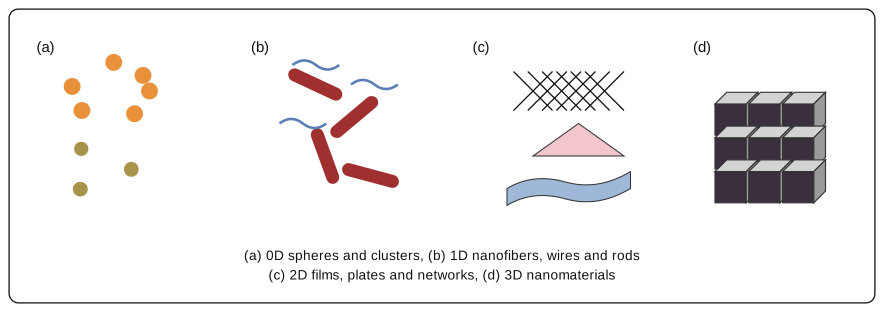
What this figure shows. A summary figure classifying nanomaterials into four categories by dimensionality, extending the 0D/1D/2D classification already introduced in Section 16.5.4 to also include a fourth 3D category: (a) 0D -- spheres and clusters; (b) 1D -- nanofibers, wires and rods; (c) 2D -- films, plates and networks; (d) 3D -- nanomaterials (bulk materials built up from nanoscale building blocks, such as nanocrystalline or nanostructured bulk solids, rather than materials that remain nanoscale in any dimension themselves). This figure's inclusion of a 3D category is broader than the 0D/1D/2D classification given earlier in the chapter (Section 16.5.4), extending it to materials whose nanoscale cha …