Chemistry · Ch 16 — Green Chemistry and Nanochemistry
What is a Nanomaterial? -- Dimensional Classification
What is a Nanomaterial? -- Dimensional Classification
A nanomaterial is defined as a material having structural components with at least one dimension in the nanometre scale, that is, in the range 1-100 nm. Nanomaterials sit in between individual atoms and living cells in size -- they are larger than single atoms but smaller than bacteria and cells -- and, depending on their overall shape, may take the form of nanoparticles, nanowires or nanotubes. At a chemical level, nanostructured materials can be large organic molecules, inorganic cluster compounds, or metallic or semiconductor particles. Nanoscale systems are classified by how many of their three spatial dimensions actually fall within the nanoscale. A zero-dimensional (0D) nanostructure -- nanoparticles being the standard example -- is one in which all three dimensions are in the nanoscale. A one-dimensional (1D) nanostructure -- nanowires and nanorods, for example -- is one in which two of the three dimensions are in the nanoscale (leaving one longer dimension, the wire's or rod's length, outside the nanoscale). A two-dimensional (2D) nanostructure -- thin films being the standard example -- is one in which only one dimension is in the nanoscale (the film's thickness), while the other two (its length and breadth) are not. A companion classification table in the source lists further examples against each class: 0D nanostructures include nanoparticles, quantum dots, nanoshells, nanorings and microcapsules; 1D nanostructures include nanotubes, fibres and nanowires; 2D nanostructures include thin films, layers and coatings. Note: the printed table's own row labels read 'All three dimensions <100 nm', 'One dimension <100 nm' and 'Two dimension <100 nm' for the 0D/1D/2D rows respectively -- read literally, the 1D row label ('one dimension <100 nm') looks inconsistent with the fuller definition given in the running text just above it, where a 1D nanostructure is instead said to have two of its three dimensions in the nanosc …
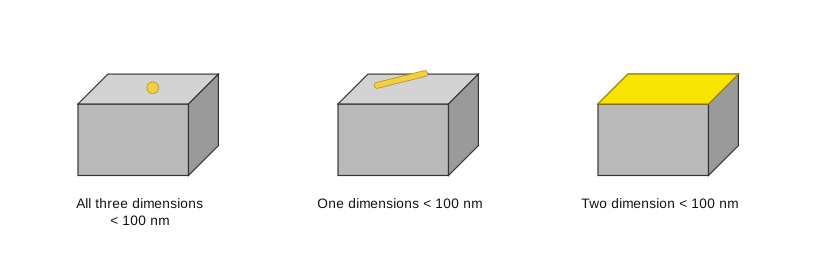
Drawn by us to help you understand the concept clearly, and verified to make sure it's accurate. For exams, practice from your textbook's own diagram.
What this figure shows. A schematic diagram illustrating the three nanostructure dimensionality classes side by side: a zero-dimensional (0D) structure drawn as a small sphere/particle with all three of its spatial dimensions confined to the nanoscale; a one-dimensional (1D) structure drawn as an elongated wire or rod shape, with two of its three dimensions (its cross-sectional width and depth) confined to the nanoscale while its length extends beyond it; and a two-dimensional (2D) structure drawn as a thin flat sheet or film, with only its thickness confined to the nanoscale while its length and breadth extend beyond it. Viewing the three side by side makes the progressive relaxation of nanoscale confinement -- fro …
Nanomaterial dimension class | Nanomaterial type / examples
All three dimensions in the nanoscale (0D) | Nanoparticles, quantum dots, nanoshells, nanorings, microcapsules
Two of three dimensions in the nanoscale, one long axis outside it (1D; the printed table's own row label reads 'one dimension < 100 nm', which reads as a compressed/inconsistent label against the fuller running-text definition of 1D given just above it -- flagged rather than silently rewritten) | Nanotubes, fibres, nanowir …
What this figure shows. A figure showing the formation of a colloidal gold nanoparticle solution -- placed in the text immediately after the zero/one/two-dimensional nanostructure definitions, as a concrete real example of a 0D nanostructure (gold nanoparticles) actually being formed in solution. Colloidal gold solutions are a classic nanochemistry example because, as Section 16.6.1 goes on to explain, a gold nanoparticle solution shows a strikingly different colour (red, rather than elemental gold's familiar shining yellow) pu …