Chemistry · Ch 1 — Solid State
Packing efficiency of metal crystal in body-centred cubic lattice
Packing efficiency of metal crystal in body-centred cubic lattice
The packing efficiency of a metal crystal in the body-centred cubic lattice is obtained by the same four steps.
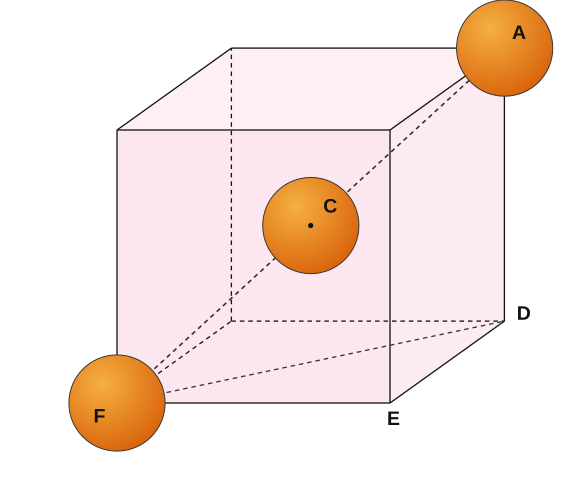
Step 1 : Radius of sphere (particle) : In a bcc unit cell the particle at the body centre touches the two corner particles that lie on the cube's body diagonal (Fig. 1.10). Consider the right-angled triangle , with . By the Pythagoras theorem, the face diagonal satisfies
Next consider the right-angled triangle , with . The body diagonal satisfies
The body diagonal spans the radius of the corner sphere at , the full diameter of the body-centre sphere, and the radius of the corner sphere at , so . Hence , that is
Drawn by us to help you understand the concept clearly, and verified to make sure it's accurate. For exams, practice from your textbook's own diagram.
What this figure shows. A 3-D perspective cube with three shaded spheres drawn along its body diagonal: a corner sphere at , the body-centre sphere , and the opposite corner sphere at , touching one another in a line. Further vertices and are labelled, and dashed construction lines mark the face diagonal and body diagonal -- the right triangles and used with the Pythagoras theorem to show . Only the three diagonal s …
Step 2 : Volume of sphere :
Step 3 : Total volume of particles : A bcc unit cell contains 2 particles, so the total occupied volume is
…