Mathematics · Ch 9 — Applications of Derivatives
Increasing and decreasing functions
Increasing and decreasing functions
Increasing functions. A function is said to be monotonically (or strictly) increasing on an interval if, for any with , we have .
To connect this definition to the derivative: consider an increasing function on , and let be a small increment in . Since , and is increasing, , so , and dividing by the positive quantity : . Taking the limit as : , i.e. .
Moreover, if , then in a small neighbourhood around , is strictly increasing: for , one can show .
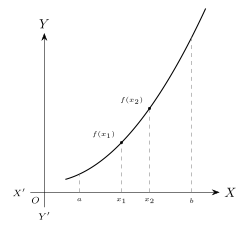
Drawn by us to help you understand the concept clearly, and verified to make sure it's accurate. For exams, practice from your textbook's own diagram.
What this figure shows. This figure shows a rising curve over an interval , with a small tangent line segment sketched at a sample point on the curve, drawn sloping upward from left to right. It illustrates that for an increasing function, moving from a point to a slightly larger point takes the curve to a strictly higher value, so the sketched tangent's slope is positive, ma …
Decreasing functions. A function is monotonically (strictly) decreasing on if, for any with , we have . By an entirely analogous argument (now for ), this leads to wherever is decreasing, and implies is strictly decreasing in a small neighbourhood of .
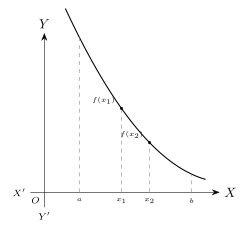
Drawn by us to help you understand the concept clearly, and verified to make sure it's accurate. For exams, practice from your textbook's own diagram.
What this figure shows. This figure shows a falling curve , with a small tangent line segment sketched at a sample point, drawn sloping downward from left to right. It illustrates the decreasing-function case that immediately precedes Example 1 in this section: moving to a slightly larger -value takes the curve to a strictly lower value, so the sketched tangent's slope is negative, ma …
Note: wherever , the tangent is parallel to the X-axis, but this alone does not tell us whether is increasing or decreasing at that point — that must be decided from the behaviour of on either side.
Worked Example 1. Show that is strictly increasing for all . . Since for all real and , everywhere, so is strictly increasing on all of .
Worked Example 2. Test whether is increasing or decreasing for all . . Since for all (and is strictly positive except at the single point ), everywhere, so is increasing for all . …