Mathematics · Ch 9 — Applications of Derivatives
Rolle's Theorem or Rolle's Lemma
Rolle's Theorem or Rolle's Lemma
Rolle's Theorem (or Rolle's Lemma): if a real-valued function is continuous on the closed interval , differentiable on the open interval , and , then there exists at least one point in the open interval such that .
In words: any real-valued, differentiable function that takes the same value at two distinct points must have at least one stationary point (where the first derivative — the tangent's slope — is zero) somewhere strictly between them.
Geometrical significance. If is continuous on (so its graph can be drawn without lifting the pen from to ) and differentiable on (so the graph has a well-defined tangent at every interior point, with no sharp corners or vertical tangents), and if the graph starts and ends at the same height (), then the graph must rise and then fall (or fall and then rise) somewhere in between — and at the very top (or bottom) of that rise-and-fall, the tangent to the curve is momentarily horizontal, i.e. parallel to the X-axis, since forces the curve to "return" to its starting height.
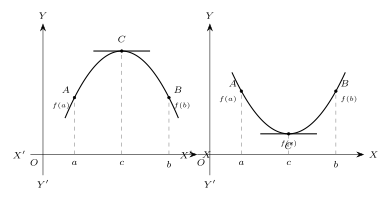
Drawn by us to help you understand the concept clearly, and verified to make sure it's accurate. For exams, practice from your textbook's own diagram.
What this figure shows. This figure illustrates Rolle's Theorem geometrically. A smooth curve is drawn over the closed interval , starting and ending at the same height since . The curve rises and then falls (or dips and then rises) between the two endpoints, and the figure marks an interior point strictly between and at which the tangent line drawn to the curve is horizontal, i.e. parallel to the X-axis — visually showing that the curve must turn around somewhere in betw …
Worked Example 1 — Checking the hypotheses. (i) For on : this is a polynomial, so it is automatically continuous on the closed interval and differentiable on the open interval. Checking the endpoint values: and . Since , all the conditions of Rolle's theorem are satisfied. (ii) For on : again a polynomial (smooth everywhere), but while ; since , the conditions of Rolle's theorem are NOT satisfied for this function on this interval.
Worked Example 2 — Full verification, finding . Verify Rolle's theorem for on . As a polynomial, is continuous and differentiable everywhere. and , so : all conditions hold. Differentiating: . Setting gives , and indeed — Rolle's theorem is verified.
Worked Example 3 — Finding given . Given that Rolle's theorem holds for on some interval with , find . Write where , which is zero exactly at and . So and , i.e. . Since is a cubic polynomial (continuous and differentiable everywhere), all the conditions of Rolle's theorem are satisfied on , so . …