Mathematics · Ch 9 — Applications of Derivatives
Lagrange's Mean Value Theorem (LMVT)
Lagrange's Mean Value Theorem (LMVT)
Lagrange's Mean Value Theorem (LMVT): if a real-valued function is continuous on the closed interval and differentiable on the open interval , then there exists at least one point in such that
In words: for any differentiable function that is continuous at its two endpoints, there is at least one point in between where the instantaneous rate of change (the tangent's slope) equals the average rate of change over the whole interval (the chord's slope). LMVT is a direct generalisation of Rolle's Theorem — Rolle's is the special case where , making the right-hand side zero.
Geometrical significance. Draw the curve and mark its endpoints and . The slope of the chord is . By the statement of LMVT, equals this chord slope for some — meaning the tangent to the curve at is parallel to the chord .
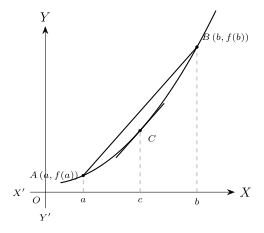
Drawn by us to help you understand the concept clearly, and verified to make sure it's accurate. For exams, practice from your textbook's own diagram.
What this figure shows. This figure illustrates the geometric meaning of Lagrange's Mean Value Theorem. The curve is drawn over with its two endpoints marked and , and a straight chord (secant line) is drawn joining and . Somewhere on the curve between and , the figure marks a point where the tangent line to the curve is drawn parallel to this chord, illustrating that the instantaneous slope …
Worked Example 1. Verify LMVT for on . The function is continuous on and differentiable on , so LMVT applies. . , . Setting equal to the chord slope: , so , giving , so , which lies in — LMVT is verified. …