Mathematics · Ch 6 — Line and Plane
Passing through two points
Passing through two points
Theorem 6.3 (vector form, two points). Suppose a line passes through two distinct points and , with position vectors and . Let , with position vector , be any other point on . Since , and are all on the same straight line, the vectors and are collinear (parallel), so for some scalar . Now and , so substituting gives , i.e. Notice this is really Theorem 6.1 in disguise: once we know two points, the vector plays exactly the role that the given direction vector played there — it is simply the direction we compute by subtracting the two known position vectors. As before, this can also be written without a parameter as .
Theorem 6.4 (Cartesian form, two points). In coordinates, if passes through and , and is any other point of , then the direction ratios of are , while the direction ratios of the line itself (found from its two known points) are . Since these two sets of direction ratios represent the same direction, they are proportional, giving Exactly as in Theorem 6.2, this is Theorem 6.2 with the direction ratios replaced by the differences computed from the two given points.
Worked examples.
Ex.(5). Find the vector equation of the line through and . Writing the position vectors as and , we first compute . By Theorem 6.3, the equation of the required line is As a check, substituting should reproduce B's position vector: , which is exactly , confirming the equation is correct.
Ex.(7). Find the Cartesian equations of the line through and — the Cartesian counterpart of Ex.(5). Here and , so by Theorem 6.4: which simplifies to the neat form (since dividing by changes nothing). One can again check that B's own coordinates satisfy this: , , — all equal, so B indeed lies on the line.
Ex.(9) — angle between two lines. Find the angle between the lines and . The angle between two lines is defined as the angle between any pair of vectors along each line, regardless of where the lines actually sit in space — so only the two direction vectors and matter here (the fact that both lines happen to pass through the same point in this particular example is incidental to the method). Using the standard dot-product formula for the angle between two vectors, The dot product is . Since the dot product is already zero, the magnitudes do not even need to be computed to know the answer: , so , meaning the two given lines are perpendicular to each other. (Carrying the magnitudes through for completeness: and , so , the same conclusion.)
Ex.(10) — showing two lines intersect. Show that the lines and intersect, and find their point of intersection. Two lines given in this general vector/parametric form intersect exactly when there is some choice of the two independent parameters, on the first line and on the second, that makes the corresponding points coincide. Writing out the general point of each line in components: on the first line it is , and on the second it is . Matching the three components gives three equations: , , and , which simplify to This is three equations in only two unknowns, so in general there is no solution at all — the lines intersect only if this particular system happens to be consistent, which can be checked by testing whether the coefficient determinant of the three equations (treating them as a system, using the third column as constants) is zero: Since this determinant is zero, the system is consistent and the lines do intersect. Solving any two of the three equations (say the first two) gives ; the third equation can then be used purely as a check, and it is indeed satisfied. Substituting back into the first line's general point gives , which is the position vector of the point of intersection. …
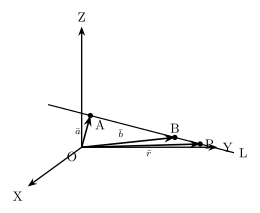
Drawn by us to help you understand the concept clearly, and verified to make sure it's accurate. For exams, practice from your textbook's own diagram.
What this figure shows. Fig. 6.2 (printed page 196) shows the two-point construction behind Theorem 6.3. The same X, Y, Z axes and origin O are drawn as in Fig. 6.1, but now the line L is fixed by two of its own points, A and B, instead of by a point and a separate direction vector. A variable point P again sits on L, between A and B. Three position vectors start at O: to A, to B, and to P. Because A, P and B all lie on the same straight line, the vector is always a scalar multiple of , which is exactly the relationship the …