Mathematics · Ch 7 — Linear Programming
Convex Sets
Convex Sets
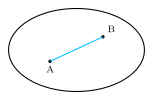
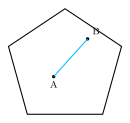
Definition (Convex set). A set of points in a plane is said to be a convex set if the line segment joining any two
points of the set lies entirely within the set. In other words, pick any two points and from the set — if the set
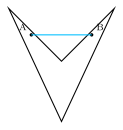
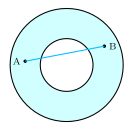
is convex, every point on the straight segment must also belong to the set; if even one pair of points has a
connecting segment that leaves the set at some point, the set is NOT convex.
Simple shapes like a full disc, a solid triangle, a rectangle, or a half-plane are all convex sets: no matter which two
points inside them you pick, the straight segment between them never pokes outside the shape's own boundary. A shape with
a "dent," a crescent, or a hole (an annulus) is NOT convex, because it is always possible to find two points inside the
shape whose connecting segment cuts across the missing region and temporarily leaves the set.
Drawn by us to help you understand the concept clearly, and verified to make sure it's accurate. For exams, practice from your textbook's own diagram.
fig 7.1(a) — a convex set (ellipse): the segment joining interior points A and B lies entirel …
Drawn by us to help you understand the concept clearly, and verified to make sure it's accurate. For exams, practice from your textbook's own diagram.
fig 7.1(b) — a convex set (pentagon): segment AB joining two interior points stays wit …
Drawn by us to help you understand the concept clearly, and verified to make sure it's accurate. For exams, practice from your textbook's own diagram.
fig 7.1(c) — a non-convex set (dart): segment AB leaves the set through the …
Drawn by us to help you understand the concept clearly, and verified to make sure it's accurate. For exams, practice from your textbook's own diagram.
fig 7.1(d) — a non-convex set (annulus / ring): segment AB crosses the central hole, …
Note (i) — convex sets may be bounded. A convex set can be a closed, finite shape that fits entirely inside some large
enough circle — every polygon, disc, or bounded region enclosed by straight or curved boundaries falls in this category,
as long as it also passes the segment test above.
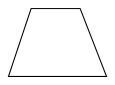
Drawn by us to help you understand the concept clearly, and verified to make sure it's accurate. For exams, practice from your textbook's own diagram.
fig 7.2(a) — a bounded convex set (trapezium) fitting within a fi …
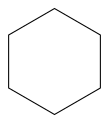
Drawn by us to help you understand the concept clearly, and verified to make sure it's accurate. For exams, practice from your textbook's own diagram.
fig 7.2(b) — a bounded convex set (he …
Note (ii) — convex sets may be unbounded. A convex set need not be finite in extent. A single half-plane (e.g. the
solution of one linear inequation ) is convex and unbounded — it stretches out indefinitely in the directions
parallel to its boundary line, yet the segment joining any two of its points still lies entirely within it, since a
half-plane has no "dent" to escape through. This distinction between bounded and unbounded convex regions becomes
important later in the chapter (section 7.2.3), because a feasible region built only from constraints (with no
matching upper bound) is typically unbounded, and an unbounded feasible region can fail to have a finite maximum even
though it is still perfectly convex.
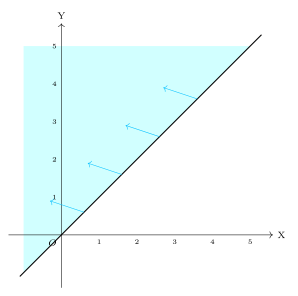
Drawn by us to help you understand the concept clearly, and verified to make sure it's accurate. For exams, practice from your textbook's own diagram.
fig 7.3(a) — an unbounded convex set: the half-plane above the line y = x, extendin …
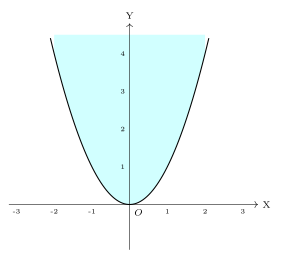
Drawn by us to help you understand the concept clearly, and verified to make sure it's accurate. For exams, practice from your textbook's own diagram.
fig 7.3(b) — an unbounded convex set: the region inside the para …
These convexity ideas are exactly what justifies the Corner-Point Method used throughout the rest of the chapter: because …