Mathematics · Ch 4 — Pair of Straight Lines
Angle between lines represented by $ax^2 + 2hxy + by^2 = 0$
Angle between lines represented by $ax^2 + 2hxy + by^2 = 0$
This section asks: given the homogeneous pair , what is the angle between its two lines?
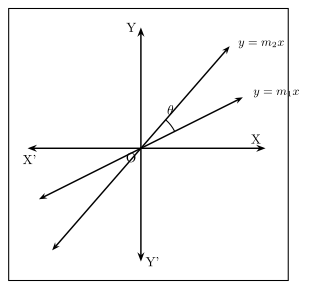
Drawn by us to help you understand the concept clearly, and verified to make sure it's accurate. For exams, practice from your textbook's own diagram.
What this figure shows. A coordinate-axis sketch (X'X horizontal, Y'Y vertical, origin O at the centre) showing two straight lines drawn through the origin and labelled by their slope-intercept forms and . It is the picture that accompanies Theorem 4.4's derivation of the acute-angle formula, illustrating the two lines whose slopes and come from the sum-and-product formulas, without itself showing the angle value that the proof goes on to …
If we know the slope of a line we can always find the angle it makes with the coordinate axes, so the natural approach is to work through the slopes of the pair (assuming , so both slopes are defined; if one line is the -axis and the angle can be found directly from the other line's slope).
Since , and two lines with slopes are perpendicular exactly when , substituting gives , i.e. , i.e. . So: the lines represented by are perpendicular to each other if and only if .
When the lines are not perpendicular, the acute angle between them is given by the following theorem.
Theorem 4.4. The acute angle between the lines represented by is given by .
Proof. Let be the slopes of the two lines, so and . Using the algebraic identity , substitute: . Taking the square root, .
Since is the acute angle between the two lines, (taking the sign of so the value comes out as the acute-angle tangent, i.e. non-negative).
Remark (coincidence). The lines represented by are coincident exactly when , i.e. , i.e. , i.e. , i.e. . This matches the coincidence remark already noted in section 4.2.
Worked Examples
Example 1. Show that lines represented by are perpendicular.
Here , so , and by the perpendicularity condition the lines are perpendicular.
Example 2. Show that lines represented by are coincident.
Here , so ; the lines are coincident.
Example 3. Find the acute angle between the lines represented by (i) , (ii) , (iii) , (iv) , (v) .
- : , so .
- : , so .
- : , so .
- : , so .
- : , so . Example 4. Find the combined equation of lines through the origin making angle with the line . …