Physics · Ch 15 — Structure of Atoms and Nuclei
Geiger-Marsden Experiment
Geiger-Marsden Experiment
To probe how an atom's positive charge is actually distributed, Rutherford proposed bombarding atoms with alpha particles -- positively charged particles (each carrying a charge of +2e, equal to that of a helium nucleus) that are far more massive than electrons and are not deflected by an atom's light electrons, only by its heavy, charged core. The experiment itself was carried out by his colleagues Hans Geiger and Ernest Marsden between 1908 and 1913.
In the apparatus, alpha particles from a radioactive source were collimated (focused into a narrow, well-defined beam) and directed at an extremely thin gold foil. Gold was chosen partly because it can be hammered into foils only a few atoms thick. Particles that scattered off the foil, at whatever angle, produced a tiny flash of light (a scintillation) on a surrounding fluorescent screen, and a microscope -- moveable to different positions around the screen -- allowed the experimenters to count how many particles scattered into each range of angles. …
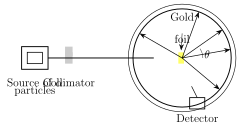
Drawn by us to help you understand the concept clearly, and verified to make sure it's accurate. For exams, practice from your textbook's own diagram.
What this figure shows. A schematic of the scattering set-up: a radioactive source emits alpha particles which pass through a collimating arrangement (slits) that focuses them into a narrow, well-defined beam travelling in one direction. This beam strikes a thin gold foil placed in its path. A circular scintillation screen surrounds the foil on all sides, and a microscope (shown mounted so it can be swung around to different positions on a graduated circular scale) is used to observe and count the tiny flashes of light (scintillations) produced wherever a scattered alpha particle strikes the screen. A representative scattered trajectory is drawn bending away from the beam's original straight-line direction, with the angle between the original beam direction and this scattered path marked as the scattering angle theta -- the sing …