Physics · Ch 15 — Structure of Atoms and Nuclei
Nuclear Binding Energy
Nuclear Binding Energy
Section 15.7.1's list of proton and neutron masses can be used to check a striking fact: the actual measured mass of any real nucleus is always slightly LESS than the sum of the masses its individual protons and neutrons would have if they were all separated and at rest, far apart from one another. For a nucleus with atomic number Z and mass number A (so N = A - Z neutrons) and actual mass M, this shortfall -- the mass defect -- is .
Where does this 'missing' mass go? By Einstein's mass-energy relation, it has been converted into energy: . This quantity, the nucleus's binding energy, has two equivalent physical meanings -- it is the energy that would be RELEASED if the individual free nucleons were brought together from far apart to form the nucleus, and equally, it is the energy that must be SUPPLIED to the nucleus to pull it completely apart into its separate, free nucleons. In practice, calculations are usually done with ATOMIC (not bare nuclear) masses, since those are what is tabulated and measured; adding and subtracting the mass of Z electrons on both sides of the equation converts the bare-nucleus formula into an equivalent atomic-mass version, , where is the mass of a whole (neutral) hydrogen atom and is the whole atomic mass of the nucleus being considered -- both readily available quantities. …
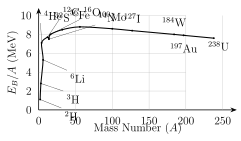
Drawn by us to help you understand the concept clearly, and verified to make sure it's accurate. For exams, practice from your textbook's own diagram.
What this figure shows. A graph with mass number A plotted along the horizontal axis and binding energy per nucleon (in MeV) plotted along the vertical axis, for nuclei across the whole range of known elements. The curve starts very low for the lightest nuclei (deuterium, with A=2, sitting at the curve's minimum, essentially zero, since it has only one proton-neutron bond), rises steeply through the light elements, reaches a broad maximum plateau (the highest, flattest part of the curve) spanning roughly A=50 to A=80, with the single highest point of the entire curve at A=56 (iron) -- marking iron as the most tightly bound, most stable nucleus of all -- and then descends slowly and smoothly for still heavier nuclei out to the heaviest naturally occurring elements like uranium, whose is …
Worked out. Lithium-7 (Li, Z=3, so N=4 neutrons) has its binding energy calculated from the atomic-mass version of the mass-defect formula, , using the given atomic masses of hydrogen (1.007825 u) and lithium-7 (7.016 u) along with the neutron mass (1.00866 u): MeV -- illustrating the standard atomic-mass bookkeeping trick (using whole atomic masses, which already include the right number of electrons, rather than separately …