Physics · Ch 4 — Thermodynamics
Change in Internal Energy of a System
Change in Internal Energy of a System
Now consider a concrete thermodynamic system: gas confined inside a cylinder fitted with a movable, massless, frictionless piston. The gas is the system; the cylinder and piston (and whatever else is around it) form the environment. Let be the gas's temperature and the environment's temperature.
The internal energy of this gas can be changed in two, entirely independent ways:
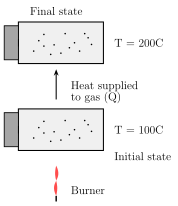
- By heating (or cooling) it. Bring the cylinder into contact with a heat source such as a burner. If the source is hotter than the gas (), the temperature difference drives a flow of heat into the gas, raising its internal energy — exactly as defined in Section 4.4.3. Conversely, if the surroundings are colder than the gas (), the gas loses energy to its environment and cools down.
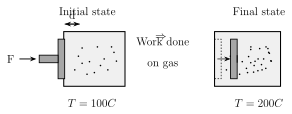
- By doing mechanical work on it (or having it do work). Instead of heating the gas, you can quickly push the piston inward, compressing the gas. The piston does work on the gas as it moves through some distance against the gas's own outward pressure; the gas gains energy from this work and its temperature rises. The reverse also happens: if the gas is allowed to push the piston outward and expand, the gas itself does work on the piston, loses energy in the process, and cools down. …
Drawn by us to help you understand the concept clearly, and verified to make sure it's accurate. For exams, practice from your textbook's own diagram.
What this figure shows. A gas in a cylinder with a movable piston, heated from below. Heat raises the gas's temperature and internal energy, and the gas expands, pushing the piston up from State 1 to State 2. This is one of the two ways to change a system's i …
Drawn by us to help you understand the concept clearly, and verified to make sure it's accurate. For exams, practice from your textbook's own diagram.
What this figure shows. The same cylinder, but now an external force pushes the piston inward through some distance, doing work on the gas. The gas is compressed, gains energy and its temperature rises — showing that work, like heat, …