Physics · Ch 7 — Wave Optics
Reflection of Light at a Plane Surface
Reflection of Light at a Plane Surface
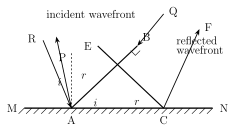
Consider a plane wavefront AB, travelling in some medium, incident at angle i (measured from the normal) on a plane reflecting surface (mirror) MN, with the mirror and the wavefront both perpendicular to the plane of the page (Fig. 7.3). Because the wavefront AB is not parallel to the mirror, its different points do not reach MN simultaneously: point A reaches the mirror first, at time ; point B, at the other end of the wavefront, only reaches the mirror later, at a point C, at time . In the interval between these two events, points along AB between A and C progressively strike the mirror and, by Huygens' principle, immediately begin emitting their own secondary (reflected) wavelets, all on the SAME side of the mirror as the original incident wave (since the wave is reflected back into the original medium, not transmitted through the mirror).
Drawn by us to help you understand the concept clearly, and verified to make sure it's accurate. For exams, practice from your textbook's own diagram.
What this figure shows. A plane wavefront AB incident at angle i on a plane mirror MN. By the time B reaches C, the wavelet from A has radius AE = BC = vT; the reflected wavefront is the tangent EC. The congruent triangles ABC and AEC give the angle of …
By time T, the secondary wavelet that started from A (the very first point to strike the mirror) has grown to its full radius ; the wavelet from C (the very last point to strike the mirror, at time T itself) has only just begun and so has radius zero; and points struck in between have wavelets of intermediate, gradually shrinking radii. The REFLECTED wavefront at time T is the common tangent (envelope) to all of these wavelets -- shown in the figure as the straight line EC, tangent to the full-radius wavelet centred at A and to every intermediate wavelet between A and C.
Since A's wavelet radius equals the distance (light travelling the same speed, in the same medium, for the same time T), the two right triangles ABC and AEC share a common hypotenuse AC and have one pair of equal sides () -- making them CONGRUENT triangles. From this congruence, . But is exactly the angle of incidence i (since ray RA is perpendicular to wavefront AB, and normal AP is perpendicular to mirror MN, the angle between RA and AP equals the angle between AB and AC, both equal to i). Likewise, since AE is perpendicular to the reflected wavefront CE, and AP is perpendicular to AC, (the angle of reflection, between the reflected ray AE and the normal AP). Combining with gives directly -- the LAW OF REFLECTION, derived purely from the geometry of Huygens' wavelet construction, with no separate assumption needed. It is also immediately clear from this same construction that the incident ray, the normal, and the reflected ray all lie in the single plane of the page -- the OTHER law of reflection. …