Physics · Ch 7 — Wave Optics
Interference
Interference
Chapter 6 introduced the SUPERPOSITION PRINCIPLE for waves: whenever two or more waves overlap at a point, the resultant displacement there is simply the algebraic sum of the individual displacements each wave would have produced on its own. Applying this to two overlapping waves of the same wavelength and amplitude: wherever their CRESTS coincide (or, equivalently, wherever their TROUGHS coincide), the two displacements add constructively, giving a resultant displacement TWICE that of either wave alone; wherever a crest of one wave coincides with a trough of the other, the two displacements are equal and opposite, and the resultant displacement is exactly ZERO. Since intensity is proportional to the SQUARE of the amplitude, this means the resultant wave's intensity is highly NON-UNIFORM in space -- large at some points, essentially zero at others -- rather than the smooth, spatially-uniform intensity a single wave alone would give. This position-dependent redistribution of intensity, arising purely from the superposition of two (or more) coherent waves, is called INTERFERENCE.
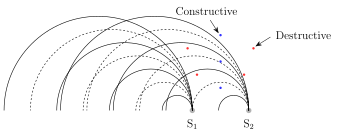
Fig. 7.9 illustrates this for two point sources of water-surface waves, of the same wavelength and amplitude and emitting exactly IN PHASE with each other at all times. Points where two crests (or two troughs) coincide are points of CONSTRUCTIVE interference (maximum displacement, twice that of either wave alone); points where a crest of one coincides with a trough of the other are points of DESTRUCTIVE interference (zero displacement). These points are not scattered randomly but line up neatly along straight radial lines emanating from the midpoint of -- so interference produces a STABLE, spatially-organised pattern of alternating reinforcement and cancellation, not a random jumble.
Drawn by us to help you understand the concept clearly, and verified to make sure it's accurate. For exams, practice from your textbook's own diagram.
What this figure shows. Two coherent sources S1 and S2 send out circular waves (solid = crests, dotted = troughs). Where crest meets crest (or trough meets trough) — the blue dots — the waves add: constructive interference. Where crest meets trough — the red dots — they cancel: destructive interference. Th …
…