Q.Give the construction and theory of an a.c. generator. OR Derive an expression for average power in -- circuit connected to an a.c. supply. What is wattless current?
You're viewing a preview — the full solution, concept, methods & PYQ mapping are locked.
Start your 14-day free trial to unlock the full solution →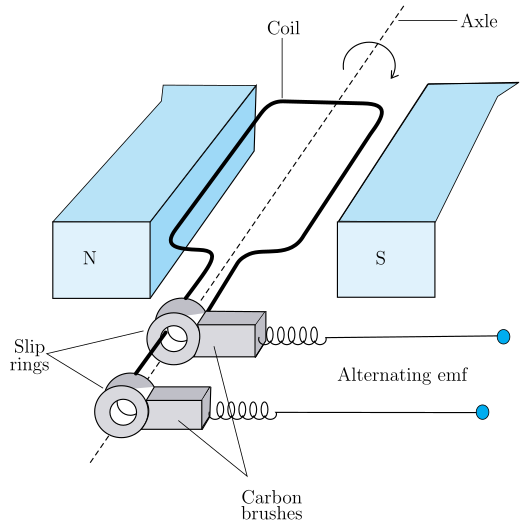
An a.c. generator converts mechanical rotational energy into electrical energy by rotating a coil in a magnetic field, using electromagnetic induction; as the coil rotates uniformly, the changing flux produces a sinusoidal e.m.f.
Construction
An a.c. generator (alternator) essentially consists of:
- Armature: a coil of many turns of insulated copper wire, wound on a soft-iron core (to increase flux linkage), mounted on a rotating shaft.
- Field magnet: strong permanent magnets or electromagnets providing a uniform magnetic field between whose poles the armature rotates.
- Slip rings: two rings fixed to the rotating shaft, rotating along with the coil, each connected to one end of the armature coil.
- Brushes: stationary carbon/graphite contacts that press against the slip rings, providing the electrical connection between the rotating coil and the stationary external circuit.
- A mechanical energy source (turbine, engine, etc.) rotates the shaft (and hence the coil) at a constant angular speed .
Theory
Let the coil (area , turns) rotate with constant angular velocity in a uniform field , with the angle between the field and the normal to the coil being at time (assuming at ). Flux linked with the coil:
By Faraday's law of electromagnetic induction, the induced e.m.f. is:
where is the peak (maximum) e.m.f. This sinusoidally varying e.m.f. is delivered to the external circuit through the slip rings and brushes — the basic principle of the a.c. generator.
…
Unlock everything free for 14 days
- Full step-by-step solutions
- Concept-first explanations
- Methods, shortcuts & mistakes
- PYQ mapping + timed mock tests
Full access for 14 days. No credit card required.