Q.Draw a properly labelled diagram showing the main components of an AC generator. OR What are Eddy currents? How can they be minimised? (1+1=2)
You're viewing a preview — the full solution, concept, methods & PYQ mapping are locked.
Start your 14-day free trial to unlock the full solution →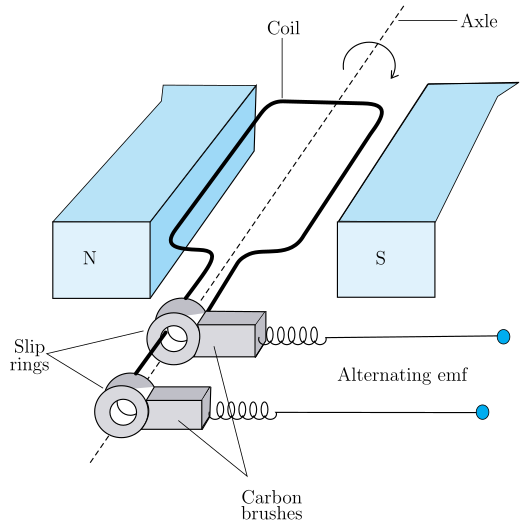
An AC generator converts mechanical (rotational) energy into electrical energy by electromagnetic induction -- a coil rotating in a magnetic field, connected to the external circuit via slip rings and brushes. In the alternative, eddy currents are unwanted induced currents inside the bulk of a conductor, reduced by laminating the core.
Main components of an AC generator
- Armature (coil) — a rectangular coil of many turns, wound on a soft-iron core, mechanically rotated.
- Field magnet — a strong permanent magnet or electromagnet providing a uniform field (pole pieces N, S) between which the armature rotates.
- Slip rings — two rings fixed to (and rotating with) the two ends of the armature coil.
- Brushes — two stationary carbon brushes pressing against the slip rings, leading the induced current to the external circuit.
- Axle/shaft — connects the armature to the external source of rotation (e.g. a turbine).
(Layout: coil sits between the N and S poles with its rotation axis perpendicular to ; each end connects to its own slip ring; the two brushes rub the two rings and connect to the external load .)
Working
As the coil rotates with angular velocity in field , the linked flux varies as , inducing
with peak emf . This sinusoidal emf drives the current delivered through the brushes and slip rings.
…
Unlock everything free for 14 days
- Full step-by-step solutions
- Concept-first explanations
- Methods, shortcuts & mistakes
- PYQ mapping + timed mock tests
Full access for 14 days. No credit card required.