Q.What is the basic principle of a rectifier? Draw a neat circuit diagram of a full-wave rectifier circuit.
You're viewing a preview — the full solution, concept, methods & PYQ mapping are locked.
Start your 14-day free trial to unlock the full solution →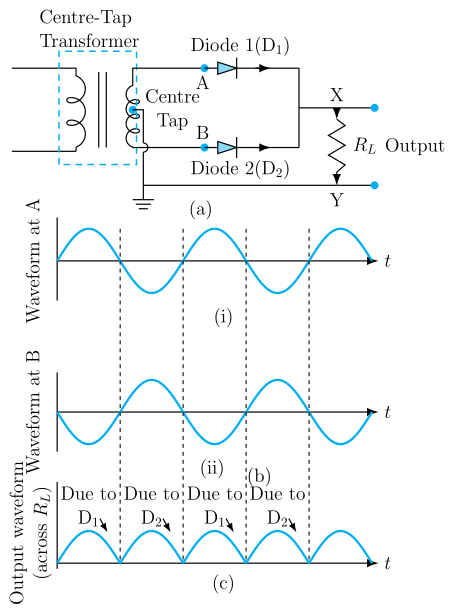
A diode conducts only one way, so feeding it an AC signal chops off (or redirects) the reverse half — a clever two-diode arrangement can flip both halves of the AC cycle the same way, giving full-wave rectification.
Basic principle
A - junction diode offers very low resistance when forward biased and very high resistance when reverse biased — it conducts essentially in only one direction. Feeding an alternating voltage to a diode therefore produces a unidirectional (pulsating) output, since only the half-cycle that forward-biases the diode drives current through the load.
Full-wave rectifier circuit
Use a transformer with a centre-tapped secondary, feeding two diodes , whose cathodes are joined together at the load (with the centre tap as the other end of the load, taken as ground/reference).
- During one half-cycle, the top of the secondary is positive: is forward biased and conducts, driving current through . …
Unlock everything free for 14 days
- Full step-by-step solutions
- Concept-first explanations
- Methods, shortcuts & mistakes
- PYQ mapping + timed mock tests
Full access for 14 days. No credit card required.