Physics · Ch 10 — Thermal Properties of Matter
Convection
Convection
Convection: The Mechanism of Fluid Heat Transfer
Heat transfer through a fluid — whether liquid or gas — happens by a fundamentally different mechanism than conduction. In conduction, energy moves through a stationary medium as atoms and molecules pass vibrational energy to their neighbours. In a fluid, the medium itself can move, carrying thermal energy along with it. This bulk motion of the fluid is the defining feature of convection.
Consider a pot of water on a stove. The water at the bottom gets hot first. As it heats, it expands, becomes less dense than the cooler water above, and rises. Cooler, denser water from the top sinks to take its place, gets heated in turn, and rises. This sets up a continuous circulation loop called a convection current. The moving fluid physically transports the thermal energy from the hot bottom to the cooler top.
Convection is therefore the transfer of heat by the actual movement of the heated fluid itself. It is the dominant mode of heat transfer in liquids and gases, and it is far more efficient than conduction in these media. A still pot of water would take an extremely long time to boil if only conduction were at work.
Convection always involves the bulk motion of the fluid. If the fluid is not moving, the only heat transfer possible is conduction — which is very slow in most fluids. This is why a layer of trapped air (as in a wool sweater or double-glazed window) is a good insulator: the air cannot circulate freely, so convection is suppressed.
Natural (Free) Convection and Forced Convection
There are two broad categories of convection, distinguished by what causes the fluid to move.
Natural convection arises because of density differences within the fluid caused by temperature gradients. The hot, less dense fluid rises; the cool, denser fluid sinks. Gravity is the driving force. The example of the pot of water on the stove is natural convection. Other examples include the circulation of air in a room near a radiator, the formation of sea breezes, and the rising of hot air in the atmosphere.
Forced convection occurs when the fluid is made to move by an external agent — a pump, a fan, a blower, or even stirring. The motion is imposed, not driven by buoyancy. Examples include a car's radiator cooling system (a pump circulates the coolant), a fan blowing air over a hot surface to cool it, and the human circulatory system (the heart pumps blood, which carries heat away from the core to the skin).
Forced convection is generally much faster and more controllable than natural convection. This is why we use fans to cool electronics and pumps to circulate coolant in engines.
The Rate of Convective Heat Transfer: Newton's Law of Cooling
While the detailed physics of convection is complex (involving fluid dynamics, viscosity, and boundary layers), a simple empirical law describes the rate at which a hot object loses heat to a cooler surrounding fluid. This is Newton's law of cooling.
Where:
- is the rate of heat transfer (power) from the object to the fluid. The negative sign indicates that the object's internal energy is decreasing (it is losing heat).
- is the convection heat transfer coefficient (or film coefficient). Its SI unit is . This coefficient is not a material constant like thermal conductivity; it depends on the geometry of the surface, the nature of the fluid flow (laminar or turbulent), the fluid's properties (viscosity, density, specific heat), and whether the convection is natural or forced.
- is the surface area of the object in contact with the fluid.
- is the temperature of the object's surface.
- is the temperature of the surrounding fluid (the ambient temperature).
The law states that the rate of cooling is directly proportional to the temperature difference between the object and its surroundings. A hotter object in a cooler room cools faster than a slightly warm object in the same room.
Newton's law of cooling is an approximate empirical law. It works well for moderate temperature differences and when the dominant mode of heat loss is convection. It does not account for radiative heat loss, which becomes significant at very high temperatures. Also, the coefficient is not truly constant over a wide range of temperatures and flow conditions.
A Simple Model for the Temperature of a Cooling Body
We can use Newton's law of cooling to derive how the temperature of a body changes with time. Assume the body has a uniform temperature at any instant, a mass , and a specific heat capacity . The rate of loss of its internal energy is:
Equating this to the convective heat loss (ignoring other modes of heat transfer):
Let be the temperature difference. Since is constant, . The equation becomes:
This is a first-order differential equation. The solution is an exponential decay:
where is the initial temperature difference, and is a constant with units of .
The temperature of a body cooling by convection alone approaches the ambient temperature exponentially. The rate of approach is determined by the constant , which depends on the body's size, material, and the convective conditions.
Convection and Trade Winds
Convection currents are not limited to a single room or a stretch of coastline — they operate on the scale of the entire planet, and one of the most striking large-scale examples is the trade wind.
The Earth's surface is heated unevenly by the Sun: the equatorial regions receive far more direct solar heating than the polar regions. This unequal heating sets up a large-scale convection current in the atmosphere — air over the hot equator rises, and air over the cold poles sinks, with surface air flowing from the poles toward the equator to replace the rising equatorial air. …
Drawn by us to help you understand the concept clearly, and verified to make sure it's accurate. For exams, practice from your textbook's own diagram.
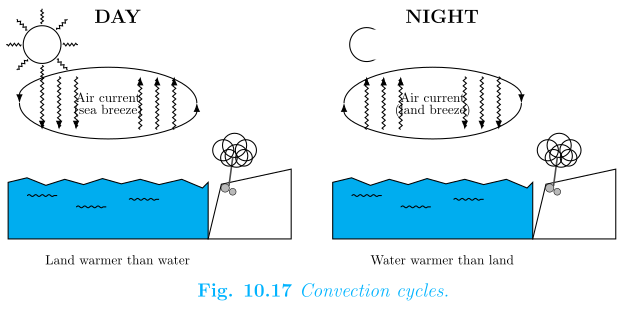
The figure shows two side-by-side panels that together explain how temperature differences drive convection currents in the air near a coastline.
Panel (a) — Day. The sun is drawn above the scene. During the day, the land heats up much faster than the adjacent sea. The air in contact with the warm land becomes hotter, expands, and rises. As it rises, cooler air from over the sea moves in to replace it — this is the sea breeze you feel on a hot afternoon. The figure labels this flow as a closed loop: air rising over land, moving out to sea at a higher altitude, sinking over the cooler water, and then flowing back toward the land at ground level. The arrowed path forms a single convection cycle.
Panel (b) — Night. A moon is shown, indicating night-time. Now the land cools down faster than the sea. The water, having a higher specific heat capacity, stays relatively warm. Air over the sea is warmer than air over the land, so it rises. The flow reverses: air rises over the sea, moves inland at height, sinks over the cooler land, and returns to the sea at ground level. This is the land breeze.
The physical idea is simple but powerful: a temperature difference between two adjacent regions creates a density difference, which generates buoyancy-driven flow. The figure makes clear that the direction of the convection cycle depends entirely on which surface is warmer.
Convection is the transfer of heat by the bulk movement of a fluid (liquid or gas). The fluid itself moves, carrying thermal energy with it. This is fundamentally different from conduction, where energy passes through a stationary medium.
The textbook does not derive a single formula directly from this figure. Instead, the figure grounds the concept of natural convection, which then leads to Newton’s law of cooling — the key formula developed in this section. Newton’s law describes how quickly a hot object loses heat to its surroundings when the temperature difference is small and the dominant mechanism is convection.
Here:
- is the rate of heat loss (energy per unit time, in watts).
- is the heat transfer coefficient (a constant that depends on the nature of the surface, the fluid, and the flow conditions — it is not a universal constant).
- is the surface area of the object exposed to the fluid.
- is the temperature of the object’s surface.
- is the temperature of the surrounding fluid (the ambient temperature).
- The negative sign indicates that heat flows out of the object when . …