Q.Explain why nucleophilic substitution reactions are not very common in phenols.
You're viewing a preview — the full solution, concept, methods & PYQ mapping are locked.
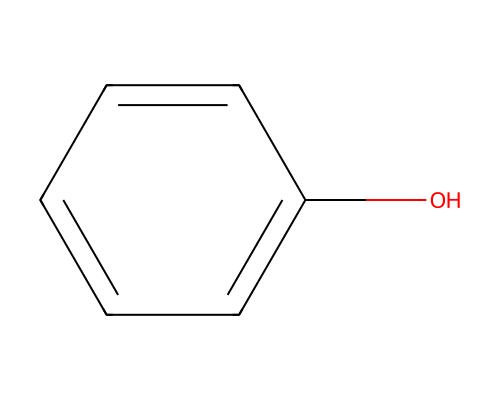
Start your 14-day free trial to unlock the full solution →Phenols resist nucleophilic substitution because the lone pair on oxygen is in conjugation with the ring, making the carbon–oxygen bond strong and partial double-bond in character — the C–O bond simply does not break easily under nucleophilic attack.
The core idea: why phenols are different
Nucleophilic substitution requires a good leaving group — something that can depart with its bonding electrons, usually as a stable anion. In alkyl halides, the halide ion (Cl⁻, Br⁻, I⁻) is a weak base and a fine leaving group. In phenols, the leaving group would be the hydroxide ion (OH⁻), which is a strong base and a terrible leaving group. That alone makes direct Sₙ2 or Sₙ1 impossible under normal conditions.
But there is a deeper, structural reason that makes phenols even more resistant than, say, simple alcohols.
Step-by-step reasoning
-
The oxygen lone pair is delocalised into the ring.
In phenol, the oxygen atom is -hybridised (or close to it). One of its lone pairs is in a p-orbital that overlaps with the π-system of the benzene ring. This conjugation creates a partial double bond between oxygen and the ring carbon. The C–O bond order is greater than 1 — it is not a simple single bond.
-
This conjugation strengthens the C–O bond.
A stronger bond means higher bond dissociation energy. Breaking the C–O bond to release OH⁻ requires much more energy than in an aliphatic alcohol. The resonance stabilisation of the phenol molecule itself also means the ground state is lower in energy, raising the activation barrier for any reaction that breaks the conjugation.
-
The leaving group would be a very poor one.
Even if the bond could be broken, the departing species would be the hydroxide ion. Hydroxide is a strong base ( of water ≈ 15.7) and a very poor leaving group. In nucleophilic substitution, good leaving groups are weak bases (like halides, tosylate, etc.). Phenols cannot provide a good leaving group without prior activation.
-
The aromatic ring is electron-rich, not electron-poor.
Nucleophilic substitution on an aromatic ring (SₙAr) typically requires the ring to be strongly electron-deficient — for example, activated by nitro groups that stabilise the Meisenheimer complex. Phenol’s ring is actually electron-rich due to oxygen’s electron-donating resonance effect. This makes it even less susceptible to attack by a nucleophile.
-
Compare with alkyl halides or activated aryl halides. …
Unlock everything free for 14 days
- Full step-by-step solutions
- Concept-first explanations
- Methods, shortcuts & mistakes
- PYQ mapping + timed mock tests
Full access for 14 days. No credit card required.