The Core Intuition: Who Wants to Leave, and Who Can Wait?
Imagine you're at a party where the host (the leaving group) is about to leave. The party (the reaction) happens in two stages. First, the host walks out the door — that's the slow, painful step. Then, a new guest (the nucleophile) rushes in to take the empty spot.
The SN1 reaction works exactly like this: the leaving group leaves first, forming a carbocation intermediate. The nucleophile attacks after the leaving group is gone. This means the rate of the reaction depends only on how easily the leaving group can leave — it does not depend on the nucleophile at all.
So the question becomes: What makes a carbocation form easily? The answer is stability. A carbocation that is more stable will form faster and last longer, making the SN1 reaction faster.
The Precise Statement of SN1 Reactivity Order
SN1 Reactivity Order (for alkyl halides):
Allylic≈Benzyl>3∘>2∘≫1∘≈Methyl
This is the order of how fast the SN1 reaction proceeds. Let's unpack why.
Why This Order? The Stability Ladder
A carbocation is a carbon with only six electrons in its valence shell — it's electron-deficient and positively charged. The more you can spread out (delocalize) that positive charge, the more stable the carbocation becomes.
1. Methyl and 1° Carbocations: The Unstable Ones
A methyl carbocation (CHX3X+) has no alkyl groups attached to the positive carbon. There is zero electron-donating effect to stabilize the charge. It is so unstable that it practically never forms in an SN1 reaction — the reaction simply doesn't happen.
A primary (1°) carbocation has one alkyl group attached. Alkyl groups are weakly electron-donating (through hyperconjugation and inductive effect), so it's slightly more stable than methyl — but still far too unstable to form under normal SN1 conditions.
Watch out
Never say "SN1 happens on a primary carbon" in an exam. It is essentially impossible under standard conditions because the carbocation is too unstable.
2. Secondary (2°) Carbocations: The Borderline Case
A secondary carbocation has two alkyl groups donating electron density. It is moderately stable — stable enough to form, but only under certain conditions (like a good leaving group and a polar protic solvent). SN1 reactions on secondary carbons are possible, but they are slower than on tertiary carbons.
3. Tertiary (3°) Carbocations: The Sweet Spot
Three alkyl groups donate electron density to the positive carbon. This makes the carbocation very stable. Tertiary alkyl halides undergo SN1 reactions readily — they are the classic example.
4. Allylic and Benzylic: The Champions
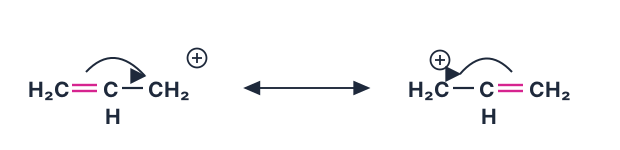
These are special cases. In an allylic carbocation, the positive charge is adjacent to a carbon-carbon double bond. The π electrons of the double bond can delocalize the positive charge onto the second carbon:
CHX2=CH−CHX2X+↔+CHX2−CH=CHX2
Two resonance structures of the allyl carbocation, CH2=CH-CH2+, with the positive charge delocalised between the two terminal carbons (Structure I and Structure II)
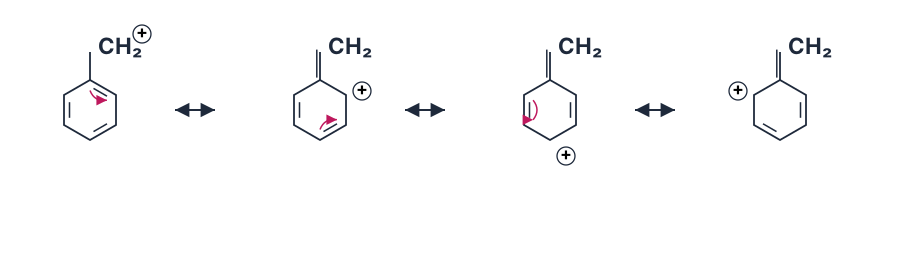
In a benzylic carbocation, the positive charge is adjacent to a benzene ring. The π system of the ring delocalizes the charge across multiple carbons:
CX6HX5−CHX2X+↔(several resonance structures)
Here are those resonance structures — the positive charge cycles from the CH₂ carbon onto the ortho and para positions of the ring:
Four resonance structures of the benzyl carbocation, C6H5-CH2+, with curved electron-pushing arrows showing the positive charge delocalising from the exocyclic CH2 carbon onto the ortho and para ring carbons
This resonance stabilization makes allylic and benzylic carbocations even more stable than tertiary ones. They form the fastest in SN1 reactions.
The Complete Picture in a Table
Carbocation Type
Stability
SN1 Reactivity
Example
Methyl
Extremely unstable
Does not occur
CHX3Br
Why this formula?
SN1 Reactivity: Why the Rate Law and Mechanism Hold
The Core Idea: A Two-Step, Carbocation-Mediated Process
SN1 stands for Substitution, Nucleophilic, Unimolecular. The "unimolecular" part is the key — the rate-determining step involves only one molecule (the substrate). This is fundamentally different from SN2, where both substrate and nucleophile collide.
The reaction proceeds in two distinct steps:
Slow step: The leaving group departs, forming a carbocation intermediate.
Fast step: The nucleophile attacks the carbocation.
Why the Rate Law is First-Order
Step 1: The Rate-Determining Step
The slow step is the heterolytic cleavage of the C–LG bond:
R–LGslowR++LG−
Since this step involves only one molecule of substrate, the rate depends only on its concentration:
Rate=k1[R–LG]
Step 2: The Fast Step
The nucleophile then attacks the carbocation:
R++Nu−fastR–Nu
Because this step is fast, it does not affect the overall rate. The nucleophile concentration does not appear in the rate law.
The Resulting Rate Law
Rate=k[R–LG]
This is first-order in substrate and zero-order in nucleophile — a hallmark of SN1.
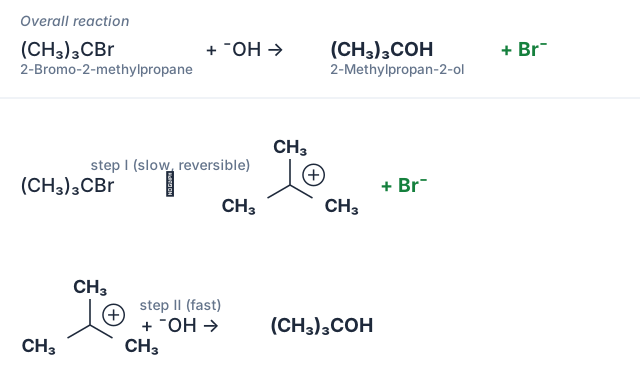
The classic example — hydrolysis of 2-bromo-2-methylpropane — shows both steps:
SN1 mechanism of 2-bromo-2-methylpropane: slow reversible ionisation to the tert-butyl carbocation (step I), then fast attack by hydroxide (step II) giving 2-methylpropan-2-ol
Why the Carbocation Stability Dictates Reactivity
The slow step involves breaking a bond without any help from the nucleophile. This creates a high-energy carbocation intermediate. The activation energy for this step depends entirely on how stable that carbocation is.
Why this order? Three factors stabilize carbocations:
Hyperconjugation: Adjacent C–H or C–C bonds donate electron density into the empty p-orbital.
Inductive effect: Alkyl groups are electron-donating, spreading the positive charge.
Resonance: Allylic and benzylic carbocations delocalize the charge across multiple atoms.
For the benzylic case, that delocalisation looks like this:
Resonance delocalisation of the benzylic carbocation: four structures with the positive charge moving from the CH2 carbon onto the ortho and para ring positions
The Reactivity Consequence
Tertiary substrates form relatively stable carbocations → fast SN1.
Primary substrates form highly unstable carbocations → SN1 is essentially impossible (the activation energy is too high).
Methyl substrates never undergo SN1 — the carbocation is too unstable.
Why the Leaving Group Must Be Good
The slow step requires the leaving group to depart with its bonding electrons. A good leaving group:
Is weakly basic (stable as an anion)
Can stabilize negative charge (large, polarizable, or resonance-stabilized)
Examples: I−, Br−, Cl−, OTs−, H2O
Poor leaving groups: OH−, OR−, NH2− — these are strong bases and will not leave easily.
Why the Solvent Matters (Polar Protic Solvents)
SN1 reactions are faster in polar protic solvents (e.g., water, methanol, ethanol). Why? …
Alkyl halides are converted to alcohols by replacing the halogen atom with an –OH group. This is a substitution reaction, making option (ii) the correct answer.
The question asks what kind of reaction turns an alkyl halide (R–X) into an alcohol (R–OH). The key is to see what changes: the halogen atom leaves and a hydroxyl group takes its place. That is the definition of a substitution — one group is swapped for another.
Let's walk through each option to see why only one fits.
Addition reaction (option (i)) — This involves adding atoms or groups across a multiple bond (like C=C or C=O). An alkyl halide has only single bonds, so there is nothing to 'add' to. No addition occurs here.
Substitution reaction (option (ii)) — This is exactly what happens. The halogen (Cl, Br, I) is replaced by –OH. For example:
CH3CH2Br+OH−→CH3CH2OH+Br−
The halogen is the leaving group, and the hydroxide ion is the nucleophile. This is a classic nucleophilic substitution (SN1 or SN2, depending on the alkyl halide).
Dehydrohalogenation reaction (option (iii)) — This removes H and X from adjacent carbons to form an alkene. It is an elimination, not a substitution. For instance:
The conversion of an alkyl halide (R–X) into an alcohol (R–OH) involves replacing the halogen atom with an –OH group. This is a substitution reaction, specifically nucleophilic substitution.
Step 2 – Recall SN1 Characteristics
SN1 = Substitution Nucleophilic Unimolecular
Occurs in two steps:
Slow step: Loss of leaving group (X⁻) to form a carbocation intermediate.
Fast step: Attack by nucleophile (OH⁻ or H₂O) on the carbocation.
The conversion of alkyl halides into alcohols is a substitution reaction — specifically, nucleophilic substitution (SN1 or SN2, depending on the alkyl halide).
Correct option: (B) substitution reaction
Common Mistakes Students Make
1. Choosing “addition reaction” (Option A)
Why students pick it:
They confuse “adding OH” with addition reactions (like adding H₂O across a double bond).
How to avoid:
Addition means adding atoms across a multiple bond (alkene → alkane, etc.).
Here, the alkyl halide has no multiple bond — the OH group replaces the halogen, not adds to it.
Remember: substitution = swap one group for another.
2. Choosing “dehydrohalogenation reaction” (Option C)
Why students pick it:
They see “alkyl halide” and “OH” and think of elimination (dehydrohalogenation gives alkenes).
How to avoid:
Dehydrohalogenation removes H and X to form a double bond (alkene).
Alcohol formation requires retaining the carbon skeleton — no double bond is formed.
Key clue: “converting into alcohols” — elimination gives alkenes, not alcohols.
3. Choosing “rearrangement reaction” (Option D)
Why students pick it:
They recall that SN1 reactions sometimes involve carbocation rearrangements.
How to avoid:
Rearrangement is a possible side process in SN1, not the main reaction type.
The question asks for the overall process — that is substitution.
Think: “What is the primary bond change?” — C–X bond breaks, C–OH bond forms. That’s substitution.
4. Confusing SN1 vs SN2 and thinking “rearrangement” is the answer