Applied Mathematics · Ch 1 — Numbers, Quantification and Numerical Applications
Boats and Streams
Boats and Streams
Boats and streams problems deal with how the speed of a boat is affected by the current, or stream, it travels through. If a boat's own speed in still water is km/hr and the stream flows at km/hr, then travelling downstream (in the same direction as the current) adds the two speeds together, while travelling upstream (against the current) subtracts them.
Downstream speed km/hr
Upstream speed km/hr
The relationship also works in reverse. If the boat's downstream speed is known to be km/hr and its upstream speed is km/hr, the boat's own speed and the stream's speed can be recovered as their half-sum and half-difference respectively: …
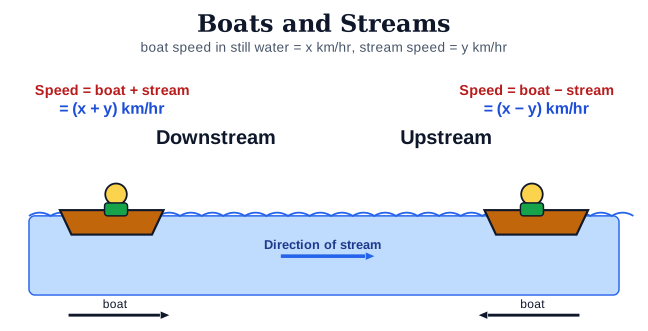
Drawn by us to help you understand the concept clearly, and verified to make sure it's accurate. For exams, practice from your NCERT textbook's own diagram.
Downstream the stream helps the boat (x + y km/hr); upstream it opposes the boat …