Applied Mathematics · Ch 1 — Numbers, Quantification and Numerical Applications
Alligation and Mixture
Alligation and Mixture
A mixture is formed by combining two or more ingredients together in a certain ratio. Alligation is the rule that works out exactly what ratio is needed — given the prices of two ingredients and the price of the desired blend, it tells you how much of each to combine.
When ingredients of different cost are mixed, the resulting cost per unit quantity of the blend is called the mean price. Of the two ingredients being combined, the one with the higher cost is the dearer ingredient, and the one with the lower cost is the cheaper ingredient.
The rule of alligation states that when ingredients are mixed to produce a mixture of a given mean price, the ratio in which they are mixed is inversely proportional to the difference between each ingredient's cost and the mean price. If is the mean price of the mixture, the cost price of the cheaper ingredient, and the cost price of the dearer ingredient, then:
…
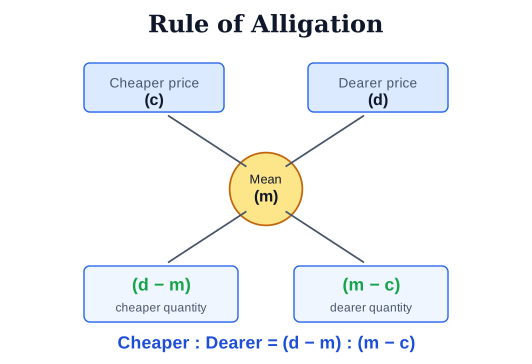
Drawn by us to help you understand the concept clearly, and verified to make sure it's accurate. For exams, practice from your NCERT textbook's own diagram.
The alligation cross: cheaper : dearer = (dearer price - mean) : (mean - c …