Applied Mathematics · Ch 1 — Numbers, Quantification and Numerical Applications
Simple Arithmetic Functions
Simple Arithmetic Functions
Recall from earlier classes that a function is a rule that assigns to every element of one set (the domain) exactly one element of another set (the range) — a kind of machine that converts an input, or pre-image, into a corresponding output, or image. For example, is a function in which is the pre-image and is the image.
A simple arithmetic function (also called a number-theoretic function) is a special case of this idea: its domain is restricted to the positive integers, while its range consists of real or complex numbers. Such functions are written as , and they exist to describe arithmetic properties of numbers — patterns like divisibility, primality, or coprimality — which makes them a core tool of number theory.
One widely used example is Euler's totient function, also called Euler's phi function and denoted . For a positive integer , counts how many integers in the set are coprime to — that is, numbers whose greatest common divisor (GCD) with equals .
Because it measures how many numbers up to share no common factor with , the totient function is a useful gauge of how "prime-like" a number's neighbourhood is, and it recurs throughout number theory and its applications.
Additive and multiplicative functions
Arithmetic functions are often classified by how they behave on a product of two coprime numbers:
- A function is additive if whenever . The logarithm is a familiar model, since .
- A function is multiplicative if whenever . Euler's totient is multiplicative: .
Properties of Euler's totient function
Three properties make easy to compute:
- If is prime, then .
- If and are coprime, then (so is multiplicative).
- If is written as a product of prime powers, then
For example, , so .
The number-of-divisors function
Denoted by the Greek letter ("tau"), this function counts how many positive divisors has:
For instance , (divisors ) and (divisors ).
The divisor-sum function
Written with the Greek letter ("sigma"), this function adds up all the positive divisors of , including and itself:
So and . For any prime the two functions take simple values, and , because a prime has exactly the two divisors and .
The Mobius function
The Mobius function, written with the Greek letter ("mu"), records the prime-factor structure of using just three values:
For example, has the repeated prime factor , so ; while is a product of two distinct primes, giving . Both and are multiplicative functions, which lets each be evaluated one prime power at a time.
Illustration 8. For , the only positive divisor is itself, so
Hence when — the count of divisors and the sum of divisors coincide, because there is a single divisor and it equals .
Illustration 9. Complete the table for prime numbers , where is the number of positive divisors and is their sum.
| (prime) | ||
|---|---|---|
| 2 | 2 | 3 |
| 5 | 2 | 6 |
| 17 | 2 | 18 |
| 29 | 2 | 30 |
A prime has exactly two positive divisors, and itself. Therefore, for every prime:
…
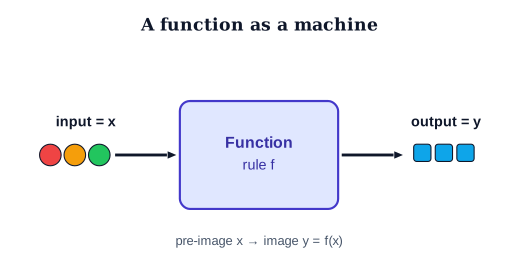
Drawn by us to help you understand the concept clearly, and verified to make sure it's accurate. For exams, practice from your NCERT textbook's own diagram.
A function pictured as a machine: it turns each input x into a single out …