Informatics Practices · Ch 6 — Societal Impacts
Social Media Etiquettes
Social Media Etiquettes
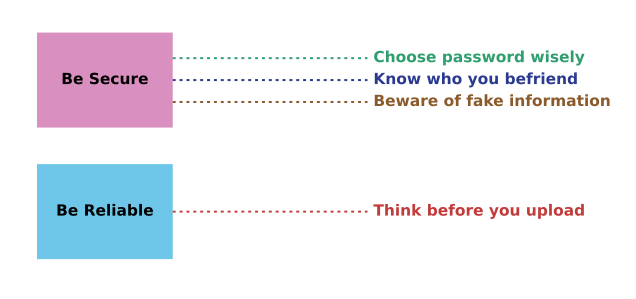
In today's digital era most of us are familiar with several kinds of social media, and we may hold an account on Facebook, Google+, Twitter, Instagram, Pinterest, or run a YouTube channel. Social media platforms are the apps and sites through which people network socially — every user can create content, publish it, and share it with the rest of the community. These platforms encourage users to share their thoughts and experiences through posts or pictures, and in doing so to interact with the other online users of those apps or channels. Because of this, the impact and outreach of social media has grown exponentially — it has begun to shape the outcomes of politics, business, culture, education and more. On social media, too, there are certain etiquettes we need to follow, summarised in Figure 6.4: choose password wisely, know who you befriend, beware of fake information, and think before you upload.
No permanent deletion! We can post or comment anything on the Internet and delete it later — but it can never be permanently deleted, because it is recorded in our digital footprint. This is exactly how many culprits who spread hate, bully others, or engage in criminal activities are traced and apprehended. …
Drawn by us to help you understand the concept clearly, and verified to make sure it's accurate. For exams, practice from your NCERT textbook's own diagram.
Figure 6.4 is two plain colour-coded boxes with dotted leader lines, not a smartphone illustration. A pink box labelled Be Secure has three dotted lines leading right to three labelled callouts: Choose password wisely (green text), Know who you befriend (blue text), and Beware of fake information (brown text). Below it, a blue box labelled Be Reliable has one dotted line leading to Think before you upload (red text). There is no phone icon or screen …
Be Secure
Being secure on social media means protecting our account, our connections, and our judgement. The textbook lists three etiquettes under this head.
-
Choose password wisely. A well-chosen password is vital for every social network user. News of breaches or leakage of user data from social networks frequently makes headlines, so users must be wary of such possibilities and know how to safeguard themselves and their accounts. The minimum we can do is to keep a strong password and change it frequently. And we must never share personal credentials — such as our username and password — with anyone else.
-
Know who you befriend. Social networks are built around connecting with other users ("making friends"), and they often encourage us to connect even with people we do not know or have never met. We need to be careful while befriending unknown people, because their intentions could possibly be malicious and unsafe. …
Be Reliable
The second head of social media etiquette concerns being reliable in what we put out on these platforms.
- Think before uploading. We can upload almost anything on a social network. But remember: once something is uploaded, it stays on the remote server even if we later delete the files. We therefore need to be cautious while uploading or sending sensitive or confidential files that have a bearing on our privacy.
The textbook reinforces this with two margin warnings:
Don't meet up! Never arrange to meet an online friend — it may not be safe. No matter how genuine someone appears online, they might be pretending and hiding their real identity.
Play safe! Think carefully before sharing personal photos.
Think and Reflect: Is having the same password for all your accounts on different websites safe? The textbook leaves this question for you to consider. …