Q.Prove that the function , given by , is one-one and onto.
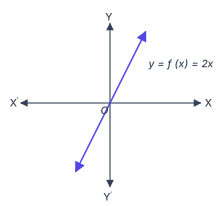
A function is one-one if each output comes from exactly one input, and onto if every real number is an output. For , we prove one-one by showing , and onto by showing for any , there exists such that . Hence is both one-one and onto (bijective).
The idea is simple: a function is a rule that pairs inputs with outputs. "One-one" (injective) means no two different inputs share the same output — think of it as each output having a unique "parent". "Onto" (surjective) means every possible output in the codomain actually gets used — nothing is left out. For , the rule is just doubling. Doubling is reversible: if you know the output, you can always halve it to get back the input. That reversibility is the heart of both properties.
Let's walk through the proof step by step.
-
Proving one-one (injective)
We need to show: if , then .
Assume . That means .
Divide both sides by 2 (which is allowed since ), and we get .
That's it — the implication holds for any . So is one-one.
TipThe key move is that multiplying by 2 is an invertible operation. If the function were , we couldn't divide both sides so cleanly because doesn't force (e.g., ). The linearity and non-zero coefficient make this trivial.
-
Proving onto (surjective)
We need to show: for every (the codomain), there exists some (the domain) such that .
Given any real number , we want . Solve for : .
Since is real, is also real — so lies in the domain .
Check: . So for every , we've found a pre-image . Hence is onto.
Watch outA common mistake is to think "onto" means the function covers all outputs it can produce — but that's not the definition. Onto means every element of the codomain (here ) is hit, not just the range. For , the range is indeed all of , so it's onto. But for with codomain , negative numbers are never outputs — so it's not onto.
-
Conclusion
Since is both one-one and onto, it is a bijection. The function is a simple linear map with slope 2 and intercept 0 — it's a straight line through the origin. Every horizontal line cuts the graph exactly once (one-one), and every horizontal line does cut it (onto). That geometric intuition matches the algebraic proof.
The function is both one-one and onto, i.e., it is a bijection from to .
Unlock everything free for 14 days
- Full step-by-step solutions
- Concept-first explanations
- Methods, shortcuts & mistakes
- PYQ mapping + timed mock tests
Full access for 14 days. No credit card required.