Mathematics · Ch 1 — Relations and Functions
Types of Functions
Types of Functions
1.3 Types of Functions
Building on Class XI Foundations
In Class XI you studied the identity, constant, polynomial, rational, modulus, and signum functions, and how to add, subtract, multiply, and divide functions. Now we go deeper — not into new functions, but into the kinds of behaviour a function can exhibit: how it pairs elements of its domain with those of its codomain.
Consider four functions shown in Fig 1.2 of the textbook. In , distinct inputs always give distinct outputs. In , two inputs (1 and 2) share the output . In , every codomain element is hit by some input. In , both properties hold at once. These lead to three definitions.
One-One (Injective) Functions
A function is called one-one (or injective) if the images of distinct elements of under are distinct. Equivalently, for every ,
If a function is not one-one, it is called many-one.
To prove a function is one-one, assume and deduce . To prove it is not one-one, exhibit a single counterexample — distinct with .
In Fig 1.2, and are one-one; and are many-one.
Onto (Surjective) Functions
A function is called onto (or surjective) if every element of is the image of some element of : for every there exists such that .
is onto if and only if the range of equals the codomain .
In Fig 1.2, and are onto; is not onto because and in are never reached.
Bijective Functions
A function is called one-one and onto (or bijective) if it is both injective and surjective.
The function in Fig 1.2(iv) is bijective.
Properties of Functions on Finite Sets …
One-one (injective) function
A function is one-one (or injective) if distinct inputs always have distinct images. Precisely, for every ,
Equivalently, : no two different elements of can share the same image. A function that is not one-one is called many-one. …
Onto (surjective) function
A function is onto (or surjective) if every element of the codomain is hit: for every there exists at least one such that .
Equivalently, the range of equals the whole set — no element of is left without a pre-image. …
Definition 7: Bijective Function (One‑One and Onto)
A function is said to be one‑one and onto (or bijective) if it satisfies both conditions:
-
One‑one (injective): For every ,
.
(Different inputs map to different outputs.)
-
Onto (surjective): For every , there exists some such that .
(Every element of is the image of at least one element of .)
In short:
is bijective is both injective and surjective.
Intuition
Think of a bijection as a perfect pairing between the sets and :
- No two different 's share the same (one‑one).
- Every gets matched to some (onto).
So a bijection is like a one‑to‑one correspondence — each element of is paired with exactly one element of , and vice versa.
Tiny Concrete Example
Let and . …
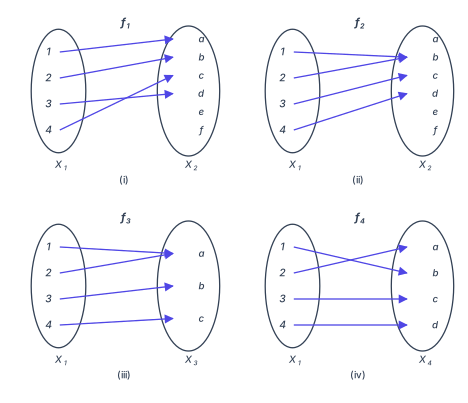
Drawn by us to help you understand the concept clearly, and verified to make sure it's accurate. For exams, practice from your NCERT textbook's own diagram.
Fig 1.2 is a set of four mapping diagrams that visually define the core types of functions: one-one (injective), many-one, onto (surjective), and bijective. Each diagram shows a left oval labelled (the domain) and a right oval (the codomain), with indigo arrows connecting elements.
In diagram (i), the function sends , , , into . Every element of gets a distinct image — no two arrows land on the same element in . This is a one-one (injective) map. Notice that and in the codomain have no incoming arrows; they are not the image of any element of . So is not onto.
Diagram (ii) shows : both and map to , while and . Because two different domain elements share the same image, this is a many-one function. It is also not onto, since , , and are unused.
In diagram (iii), maps into . Here and both go to , , . Every element of receives at least one arrow — the function is onto (surjective). But because and share the same image, it is many-one, not one-one.
Diagram (iv) shows into with crossing arrows: , , , . Every domain element has a distinct image (one-one), and every codomain element is hit (onto). This is a bijection — both one-one and onto.
The key insight from these diagrams is that one-one and onto are independent properties. A function can be one-one without being onto (diagram i), onto without being one-one (diagram iii), both (diagram iv), or neither (diagram ii).
The textbook uses these visual examples to introduce three formal definitions. A function is:
- One-one (injective) if implies for all . Equivalently, distinct elements of map to distinct elements of .
- Onto (surjective) if for every , there exists some such that . This means the range of equals the entire codomain .
- Bijective if it is both one-one and onto.
…