Concept understanding — Trigonometric Functions and Their Graphs
Trigonometric ratios were first defined only for acute angles inside a right triangle. This concept develops the full picture: trigonometric functions defined for any angle (or any real number), the rules that govern their signs and symmetry, and how they behave graphically.
1. From ratios to functions — the coordinate definition. Place an angle θ in standard position at the origin, initial side along the positive x-axis. Let P(x,y) be any point (other than the origin) on the terminal side, and r=OP=x2+y2. Then
This matches the right-triangle ratios exactly when θ is acute, but now works for anyθ. Since ∣x∣,∣y∣≤r, we always have −1≤sinθ≤1 and −1≤cosθ≤1. The value obtained does not depend on which point P is chosen on the terminal side (similar triangles give the same ratio).
Taking P on the unit circlex2+y2=1 makes r=1, so cosθ=x and sinθ=y directly — the point Pis(cosθ,sinθ). This gives the exact values at the quadrantal angles:
θ
0∘
90∘
180∘
270∘
360∘
cosθ
1
0
−1
0
1
sinθ
0
1
0
−1
0
from which sinθ=0⟺θ=nπ and cosθ=0⟺θ=(2n+1)π/2 for integer n; tanθ is undefined exactly where cosθ=0. Also, any two angles differing by a whole multiple of 360∘ (2π) give identical values for every trigonometric function.
2. Signs — the ASTC rule. Since x,y change sign across the four quadrants while r>0 always, each function's sign is fixed by the quadrant of θ:
Quadrant
Positive
Negative
I (x>0,y>0)
all six
—
II (x<0,y>0)
sin,cosec
cos,sec,tan,cot
III (x<0,y<0)
tan,cot
sin,cosec,cos,sec
IV (x>0,y<0)
cos,sec
sin,cosec,tan,cot
Remembered by the mnemonic 'All Students Take Chocolate' (quadrants I, II, III, IV in order: All, Sine, Tangent, Cosine, each together with its reciprocal). Given one function's value and the quadrant, the Pythagorean identity sin2θ+cos2θ=1 (or 1+tan2θ=sec2θ) fixes the paired ratio up to a sign, and ASTC picks the correct sign; the remaining four functions then follow from the quotient identities (tan=sin/cos, cot=cos/sin) and reciprocal identities (cosec=1/sin, sec=1/cos).
3. Extending to real numbers — the wrapping function. For applications beyond geometry (waves, oscillations, calculus), trigonometric functions are extended to any real number t, not just an angle. Starting at A(1,0) on the unit circle, wrap an arc of length ∣t∣ around the circle — anticlockwise if t>0, clockwise if t<0 — to reach a point B(x,y). Since the circle has radius 1, the arc length equals the subtended angle θ in radians, so we simply define sint=sinθ=y and cost=cosθ=x. Every property already established for angles (bounds, signs, periodicity) carries over unchanged to real-number inputs.
4. Allied angles. Two angles are allied if their sum or difference is an integer multiple of π/2: so −θ,π/2±θ,π±θ,3π/2±θ,2π±θ are all allied to θ. Reflecting P(a,b) across the x-axis (to find the ratios of −θ) gives P′(a,−b), so sin(−θ)=−sinθ and cos(−θ)=cosθ (and hence tan(−θ)=−tanθ, etc.) — these two negative-angle facts are also exactly why cosine is even and sine is odd (point 6 below). A quarter-turn rotation similarly gives sin(90∘+θ)=cosθ, cos(90∘+θ)=−sinθ. Every allied-angle case (for 0<θ<π/2) is summarised in one table:
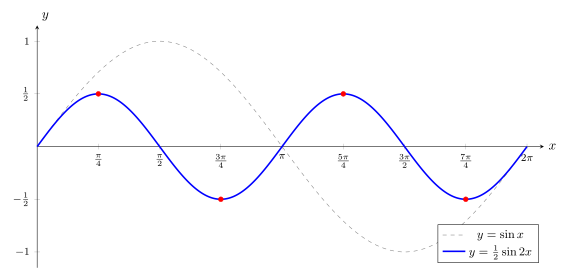
Compared to the base curve y=sinx, the curve y=21sin2x has half the amplitude and half the period, so it oscillates twice as fast and reaches only half as high. …
Starting from y=sinx (amplitude 1, period 2π), y=21sin2x halves the amplitude to 0.5 and halves the period to π, so its graph is a flatter sine wave that completes two cycles in the space of one cycle of sinx.
The base curve y=sinx has amplitude 1 and period 2π, starting at (0,0), rising to a maximum of 1 at x=π/2, back to 0 at x=π, down to a minimum of −1 at x=3π/2, and back to 0 at x=2π.
For y=21sin2x: replacing x by 2x inside the sine compresses the period by a factor of 2 (new period =2π/2=π), and the factor 21 outside scales the amplitude down to 0.5 (new range [−0.5,0.5]).
A table of values over one period of the base curve, [0,2π]: