Q.(a) Draw and label the L.S. of human brain. OR
You're viewing a preview — the full solution, concept, methods & PYQ mapping are locked.
Start your 14-day free trial to unlock the full solution →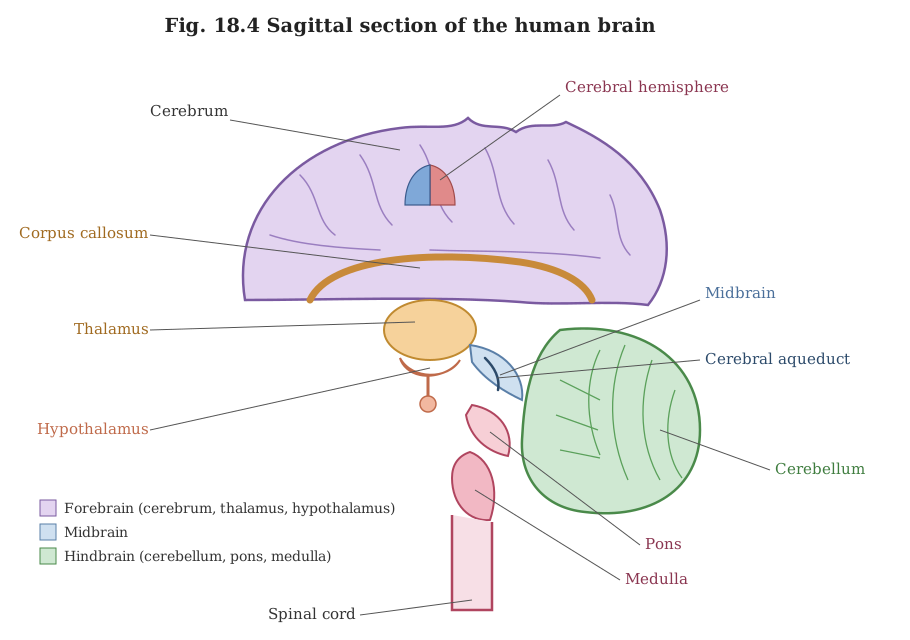
A longitudinal section of the human brain shows the cerebrum, thalamus, hypothalamus, midbrain, pons, cerebellum, and medulla oblongata continuing into the spinal cord, arranged from front-top to back-bottom.
Answering part (a): I cannot produce an actual hand-drawn diagram in this text format, so here is the labelled structure of a longitudinal section (L.S.) of the human brain described part by part, exactly as it should appear in the diagram (an honest substitute for a drawing, following the platform's content rules). Working from the front/top of the brain toward the back and downward toward the spinal cord: (1) Cerebrum — the largest, most anterior and uppermost part of the brain, divided into two cerebral hemispheres (left and right) by a deep longitudinal fissure, with its surface (cerebral cortex) thrown into folds (gyri) and grooves (sulci); it is the centre for higher functions such as sensory perception, voluntary movement, thought, and memory. (2) Corpus callosum — a thick band of nerve fibres seen in section beneath the cerebrum, connecting the two cerebral hemispheres. (3) Thalamus — a relay centre for sensory information, located centrally below the corpus callosum. (4) Hypothalamus — located just below the thalamus, regulating body temperature, hunger, thirst, and linking to the pituitary gland. (5) Pituitary gland — a small gland seen hanging below the hypothalamus by a stalk. (6) Pineal gland — a small gland located near the back of the thalamus. (7) Midbrain — a short segment connecting the forebrain to the hindbrain, involved in visual and auditory reflexes. (8) Pons — a bulging structure below the midbrain, relaying signals between the cerebrum and cerebellum. (9) Cerebellum — a folded structure located behind and below the cerebrum, at the back of the brain, responsible for coordinating voluntary movement, posture, …
Unlock everything free for 14 days
- Full step-by-step solutions
- Concept-first explanations
- Methods, shortcuts & mistakes
- PYQ mapping + timed mock tests
Full access for 14 days. No credit card required.